Proton sharing in polycarboxylic acids in aqueous solution
Fr, 16.10.2026 | Original article from: IOCB Prague
Researchers used X-ray photoelectron spectroscopy to investigate proton sharing in biologically relevant polycarboxylic acids, revealing the crucial role of molecular geometry.
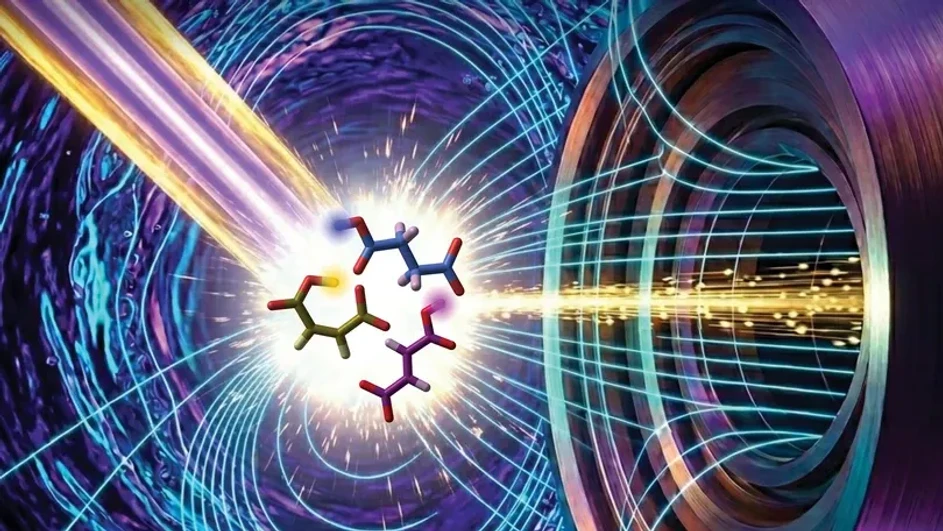
<p><strong>IOCB Prague: </strong>Cropped part of the cover by Schewe et al. with the use of Nano Banana 2.0</p>

IOCB Prague: Cropped part of the cover by Schewe et al. with the use of Nano Banana 2.0

Protons play a central role in many chemical reactions in living organisms. In some cases, a proton may be shared between two nearby molecular groups rather than being localized on just one. This phenomenon can strongly influence the properties and reactivity of biomolecules and is important for enzyme function.

Researchers led by Hanns Christian Schewe (IOCB Prague and Heyrovský Institute of the CAS) together with Lukáš Tomaník (UCT Prague and Fritz Haber Institute of the Max Planck Society) have now investigated proton sharing in a range of biologically relevant polycarboxylic acids dissolved in water, including several molecules related to the citric acid cycle (Krebs cycle).

Using liquid-jet X-ray photoelectron spectroscopy (LJ-PES), a technique that reveals the chemical environment of atoms in molecules dissolved in water, the team was able to probe the position of protons on an ultrafast time scale. Unlike techniques such as NMR, which provide a time-averaged picture, photoelectron spectroscopy captures the instantaneous distribution of protons and can therefore distinguish more directly between localized and shared states.

The results showed significant proton sharing only in maleic acid dissolved in water. In contrast, protons remained mostly localized at individual carboxylic groups in succinic acid, fumaric acid, malic acid, glutaric acid and citric acid. This suggests that proton sharing is not a common feature of these molecules when they are freely dissolved in water.
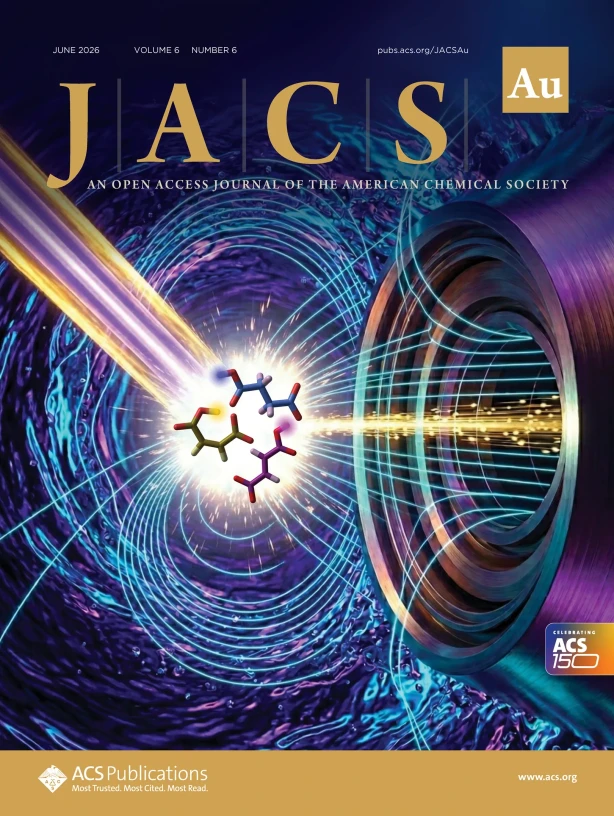
IOCB Prague: Cropped part of the cover by Schewe et al. with the use of Nano Banana 2.0: Full cover by Schewe et al. with the use of Nano Banana 2.0.IOCB Prague: Cropped part of the cover by Schewe et al. with the use of Nano Banana 2.0: Full cover by Schewe et al. with the use of Nano Banana 2.0.

The difference appears to be largely controlled by molecular geometry. In maleic acid, the two carboxylic groups are held close together, creating favorable conditions for proton sharing. More flexible molecules can adopt conformations in which the groups are farther apart, while water molecules form strong hydrogen bonds with them and favor localized protons.

However, the situation may be different inside proteins. When a carboxylic acid binds in the active site of an enzyme, its shape and position can be tightly constrained. Such an environment could bring the relevant groups close enough together to promote proton sharing and thereby influence enzymatic reactions.

The study highlights an important distinction: proton sharing may be rare in freely hydrated molecules but could become important when biomolecules are held in the right geometry by enzymes. It also demonstrates that LJ-PES is a powerful tool for studying proton behavior in solutions. Its ultrafast and site-specific sensitivity could in future help researchers investigate proton sharing directly in more complex chemical and biological systems.

The original article

Proton Sharing in Polycarboxylic Acids in Aqueous Solution

Lukáš Tomaník, Jiří Tůma, Gunnar Öhrwall, Ronny Golnak, Ngoc Lan Le Nguyen, Bruno Credidio, Harmanjot Kaur, Petr Slavíček, Bernd Winter, H. Christian Schewe

JACS Au, 2026, 6, 3349–3355

https://doi.org/10.1021/jacsau.6c00377

licenced under CC-BY 4.0

Abstract

We investigate proton sharing in biologically relevant polycarboxylic acids in aqueous solutions using liquid-jet X-ray photoelectron spectroscopy. In contrast to techniques that record time-averaged proton positions, like nuclear magnetic resonance, photoelectron spectroscopy captures instantaneous proton distribution due to its ultrafast probing time scale. The method is, therefore, uniquely sensitive to the occurrence of proton sharing in an aqueous environment, as demonstrated here. We only observe significant proton sharing dynamics in maleic acid, where its monoanionic form shows a single, delocalized peak in the carbon 1s spectrum. Conversely, succinic acid, fumaric acid, malic acid, glutaric acid, and citric acid exhibit distinct peaks corresponding to separate, localized COOH and COO– groups, instead of shared protons. Our results reveal that intramolecular proton sharing in water is rather an exception for most biologically relevant polycarboxylic acids. This highlights the importance of enzyme-driven structural changes of polycarboxylic acids associated with proton sharing during metabolic processes.


Institute of Organic Chemistry and Biochemistry of the Czech Academy of Sciences
LinkedIn Logo
 

Related articles

A multiplatform metabolomics/reactomics approach as a powerful strategy to identify reaction compounds generated during hemicellulose hydrothermal extraction from agro-food biomasses
Scientific article | Food

A multiplatform metabolomics/reactomics approach as a powerful strategy to identify reaction compounds generated during hemicellulose hydrothermal extraction from agro-food biomasses

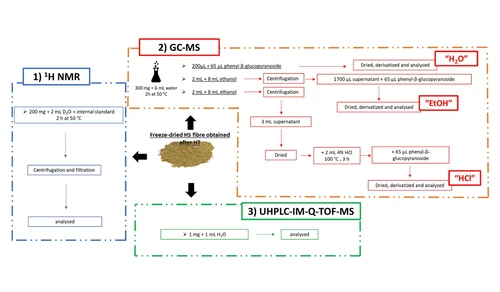
The researchers explored the metabolomics of degradation compounds formed during hydrothermal treatment of hazelnut shells, a process commonly used for hemicellulose extraction.
Enhancing Paper’s Mechanical Strength and Antibacterial Properties through a Biopolymer-Based Coating
Scientific article | Science and research

Enhancing Paper’s Mechanical Strength and Antibacterial Properties through a Biopolymer-Based Coating

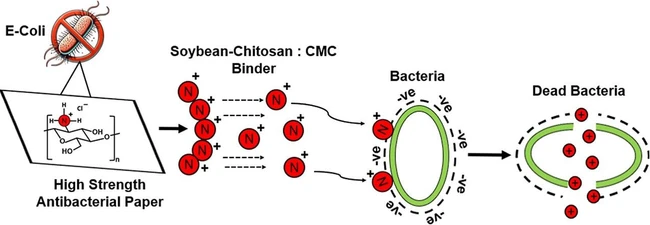
Soybean flour–CMC biopolymer coating enhanced paper strength by 61.8% and showed up to 89% antibacterial reduction against E. coli, offering promise for sustainable packaging.
Quantifying Citrate Surface Ligands on Iron Oxide Nanoparticles with TGA, CHN Analysis, NMR, and RP-HPLC with UV Detection
Scientific article | Science and research

Quantifying Citrate Surface Ligands on Iron Oxide Nanoparticles with TGA, CHN Analysis, NMR, and RP-HPLC with UV Detection

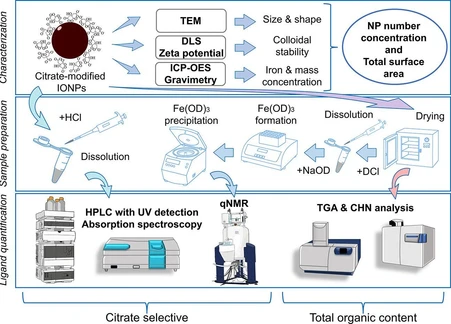
This study presents a multimethod strategy to quantify citrate ligands on iron oxide nanoparticles using TGA, CHN, qNMR, and RP-HPLC, showing how selective methods improve accuracy and prevent overestimation.
Electron spectroscopy for chemical analysis of liquids
Scientific article | Science and research

Electron spectroscopy for chemical analysis of liquids

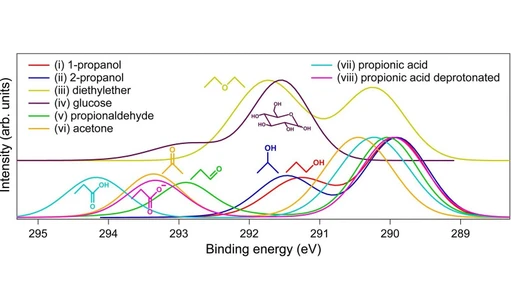
This study establishes ESCAL reference data for liquid-phase chemical analysis, revealing solvent-dependent core-level chemical shifts.