Tu, 13.10.2026 | Original article from: Thermo Fisher Scientific / Thomas Moehring
Orbitrap Astral Zoom shifts key proteomics trade-offs, enabling deeper and faster plasma, DIA, single-cell, immunopeptidomics, and XL-MS workflows.Rethinking What’s Possible in Biological Research with the Orbitrap Astral Zoom Mass Spectrometer
- Photo: Thermo Fisher Scientific: Rethinking What’s Possible in Biological Research with the Orbitrap Astral Zoom Mass Spectrometer
- Video: Chromatography & Mass Spectrometry Solutions: Realize a universe of possibilities with the Orbitrap Astral Zoom Mass Spectrometer
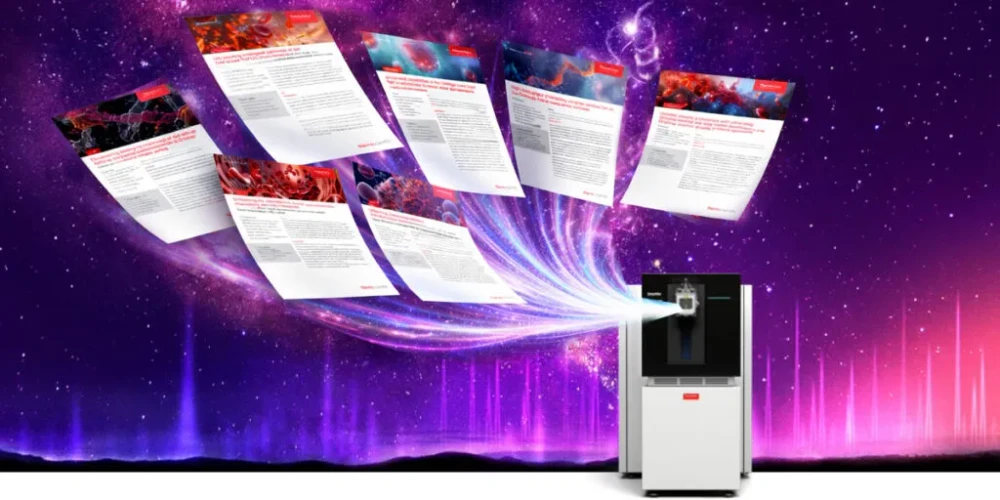
Proteomics has always been shaped by trade-offs. Depth comes at the cost of throughput. Sensitivity limits what can be measured. Mass spectrometer acquisition strategy dictates what kind of biology can be explored. These constraints are not theoretical; they define what experiments are even worth attempting. Across recent technical notes on the Thermo Scientific Orbitrap Astral Zoom Mass Spectrometer, these constraints start to shift in a noticeable way. The studies cover very different applications, plasma proteomics, immunopeptidomics, single-cell proteomics, crosslinking mass spectrometry (XL-MS), and data-independent acqusition (DIA) method development, but they all point to the same conclusion, the mass spectrometer is no longer the limiting factor.
 Thermo Fisher Scientific: Rethinking What’s Possible in Biological Research with the Orbitrap Astral Zoom Mass Spectrometer
Large-scale plasma proteomics no longer requires compromise
Plasma proteomics has always been difficult for two reasons: dynamic range and throughput. Detecting low-abundance proteins in a background dominated by high-abundance proteins is already challenging. Doing that across hundreds or thousands of samples introduces another layer of complexity, reproducibility. The high-throughput plasma workflows using the Orbitrap Astral Zoom mass spectrometer show that this is becoming less of a trade-off. With workflows incorporating Seer Proteograph ONE workflow for enrichment and DIA or hybrid-DIA for MS acquisition, the mass spectrometer can maintain depth while scaling to large cohort-level throughput. What stands out in these technical notes is not just the number of proteins identified. It is the reproducibility across runs. This is what makes these workflows relevant for biomarker discovery, where variation across samples matters more than proteome depth in a single mass spectrometry analysis.
Designing DIA around the question, not the limitation
DIA has historically been hindered by isolation window width. Wider windows increase sampling throughput but introduce interference. Narrow windows improve selectivity but reduce sampling efficiency. The narrow-window DIA workflow (nDIA) on the Orbitrap Astral Zoom mass spectrometer changes this conundrum. Because the Orbitrap Astral Zoom mass spectrometer can maintain very high acquisition speeds, narrower windows can be used without compromising the duty cycle. This directly reduces co-isolation interference while preserving proteome coverage. The newly developed hybrid-DIA approach extends this idea further. Instead of chosing one acquisition strategy on the mass spectrometer, the method combines discovery and targeted analysis within the same run. DIA is no longer just a fixed method. It becomes something you can tune based on the biological question at hand.
Making low-input proteomics more practically possible
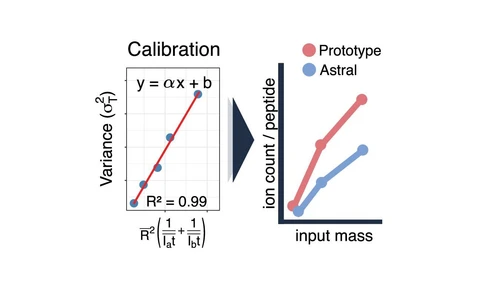
Low-input proteomics is where mass spectrometer limitations are usually most obvious. When you reduce the sample amount, everything becomes harder. The signal drops, variability increases, and missing values become unavoidable. In the single-cell proteomics technical note, the focus is not just on detecting proteins at low input. It is on maintaining proteome coverage, precision, and throughput at the same time. The Orbitrap Astral Zoom mass spectrometer achieves acquisition speeds up to 270 Hz while improving ion detection through pre-accumulation, which increases the probability of detecting low-abundance species. This combination matters because single-cell proteomics is inherently statistical. You are not measuring one cell, you are measuring many cells and comparing them. Sensitivity without throughput would not solve that problem. In the technical note, both are addressed together.
Immunopeptidomics highlights a different kind of challenge
If single-cell proteomics is limited by sample amount, immunopeptidomics is limited by peptide properties. HLA peptides are low in abundance, not generated by predictable enzymatic cleavage, and often derived from limited material. Identifying them requires both sensitivity and accuracy. The Orbitrap Astral Zoom MS shows that both abundant and rare peptides can be detected with high confidence, enabling deeper characterization of the immunopeptidome. This has direct implications for applications like neoantigen discovery, where missing low-abundance peptides means missing biologically relevant targets.
XL-MS and structural workflows benefit from speed
XL-MS is not limited by identification algorithms alone. It is limited by how many relevant MS/MS spectra you can generate in a given time. Higher acquisition speed increases the likelihood of sampling crosslinked peptides, which are often low in abundance and more difficult to fragment. The result is improved coverage of protein–protein interactions. This is not about making crosslinking easier. It is about making it more complete.
These recent technical notes are not describing independent capabilities. They are showing how the same underlying performance, speed, sensitivity, and flexible acquisition applies across very different problems.
- In plasma proteomics, it enables scale without losing consistency
- In DIA, it allows method design rather than method compromise
- In single-cell proteomics work, it supports both detection and throughput
- In immunopeptidomics, it captures rare and unconventional peptides
- In crosslinking, it increases structural coverage
Visit us on LinkedIn: #PlasmaProteomics #SingleCellProteomics #CrosslinkingMS