Fr, 9.10.2026 | Original article from: IOCB Prague
A Nature study reveals how early human embryos repair DNA during gene editing and highlights the potential and limitations of current genome-editing technologies.A study in Nature sheds new light on DNA repair in early human embryos, with implications for future gene correction
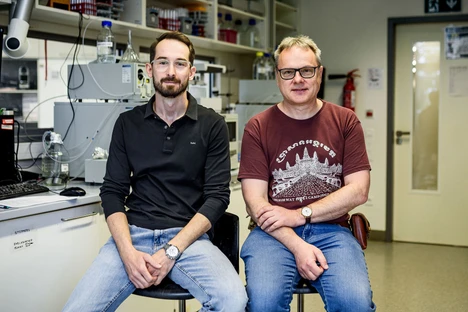
- Photo: IOCHB Prague/Tomáš Belloň: First author of the study Štěpán Jeřábek (Columbia University) with co-authors Michal Doležal and Iva Pichová (IOCB Prague)
- Video: IOCB Prague: A study in Nature sheds new light on DNA repair in early human embryosA study in Nature sheds new light on DNA repair in early human embryosA study in Nature sheds new light on DNA repair in early human embryos
Treating inherited diseases is one of the greatest challenges in modern medicine. In the future, targeted gene corrections at the earliest stages of embryonic development could help prevent certain inherited diseases from developing and being passed on to future generations. However, the safety of such approaches depends on how human embryos repair the DNA damage caused during gene editing and on the limitations of available technologies. These questions are addressed in a study published in the journal Nature, led by first author Štěpán Jeřábek, who is affiliated with both Columbia University and IOCB Prague. The research also involved two other IOCB Prague scientists, Iva Pichová and Michal Doležal.
Although DNA repair is one of the fundamental processes required for normal human embryonic development, little has been known about how it operates during the earliest stages of development. The new study is the first to provide a detailed comparison of how human embryos respond to two different types of DNA damage. “The study shows that early human embryos are able to effectively repair single-strand DNA damage, whereas the repair of double-strand breaks is significantly less reliable at this stage of development,” says the study’s first author, Štěpán Jeřábek.
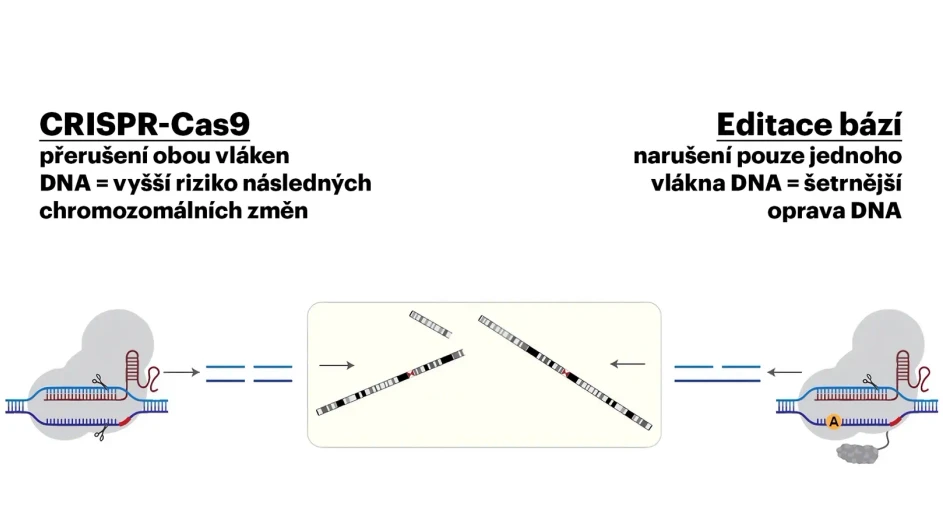 IOCHB Prague: A study in Nature sheds new light on DNA repair in early human embryos, with implications for future gene correction: The diagram illustrates the difference between CRISPR-Cas9 and base editing. The study shows that the method used to disrupt DNA affects the mechanism by which it is repaired in early human embryos. Credit: Adapted from Jeřábek et al., Nature, 2026.
To examine these repair mechanisms in detail, the researchers introduced targeted changes into two well-studied genes using two different genome-editing tools. Using CRISPR–Cas9, the researchers introduced double-strand breaks into embryonic DNA, while base editing produced only a single-strand nick. They then analyzed how the embryos' DNA repair mechanisms responded to each type of DNA damage.
Michal Doležal and Iva Pichová from IOCB Prague contributed to the purification of the protein-based editors used in the study to introduce precisely defined single-strand DNA changes. “Collaboration on the study began as early as 2021, and over the following years we prepared several editor variants for experiments carried out by our colleagues at Columbia University. Some of these were ultimately used in the study. We found that delivering the editors directly into embryonic cells as proteins, rather than as mRNA, was compatible with normal embryonic development,” says Michal Doležal.
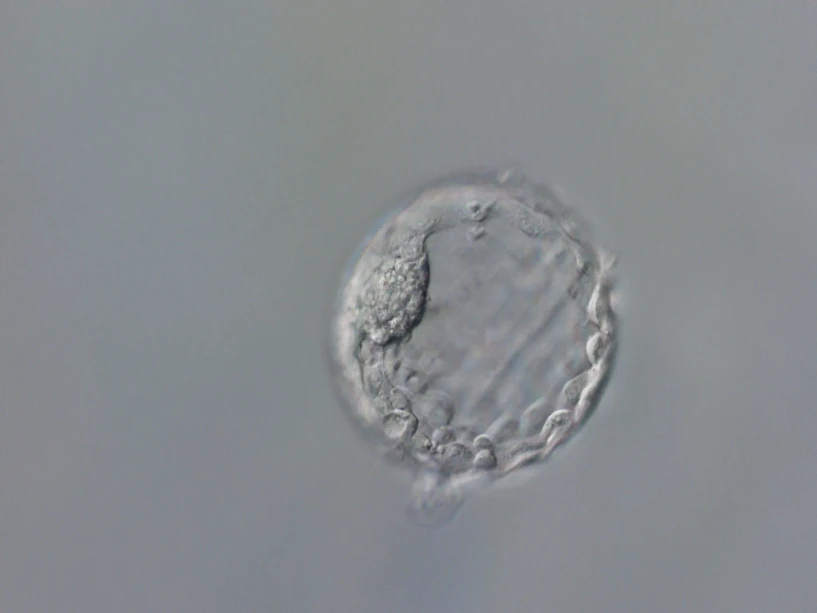 IOCHB Prague: A study in Nature sheds new light on DNA repair in early human embryos, with implications for future gene correction: A human embryo at the blastocyst stage, in whose DNA Dieter Egli's group performed base editing in the PCSK9 and HBG genes. Credit: Štěpán Jeřábek (Columbia University and IOCB Prague).
One of the study’s key findings is that the researchers successfully isolated stem cells from the edited six-day-old embryos. The stem cells provide sufficient genetic material for detailed analyses, allowing the researchers to investigate the effects of gene editing in greater depth. In addition, they make it possible to study the consequences of introduced genetic changes in subsequent generations of cells.
In addition to providing new insights into DNA repair, the study also highlights the limitations of current genome-editing technologies and the need for continuous research. “Our goal was not to develop a method for genetically modifying human embryos but rather to better understand, through basic research, how DNA repair mechanisms function in the early stages of human development. Although base editing represents a significant improvement over CRISPR–Cas9 in terms of DNA repair precision, our findings also show that many important questions regarding safety must be answered before these methods can be considered for clinical use in human embryos,” says Štěpán Jeřábek.
The research was conducted in Dieter Egli's laboratory under the oversight of Columbia University's ethics committee. Even before publication, the study attracted international attention and was covered by leading global media, including The New York Times. Jan Konvalinka, IOCB Prague Director, emphasizes that this type of basic research is important not only scientifically but also from a broader societal perspective. “I consider the ethical debate surrounding studies like this to be both legitimate and necessary. The purpose of basic research is to expand the boundaries of knowledge while helping us better understand the possibilities and limitations of current technologies. That is precisely why this work represents an important contribution to both scientific and public debate.”
The project was initially funded by IOCB Tech, the technology transfer office of IOCB Prague. After two years, the IOCB Tech Foundation took over funding for the project. “We supported this research because it was an exceptionally promising project by a talented IOCB Prague scientist at Columbia University. As we can now see, it has produced results of global significance,” says Milan Prášil, Director of IOCB Tech.
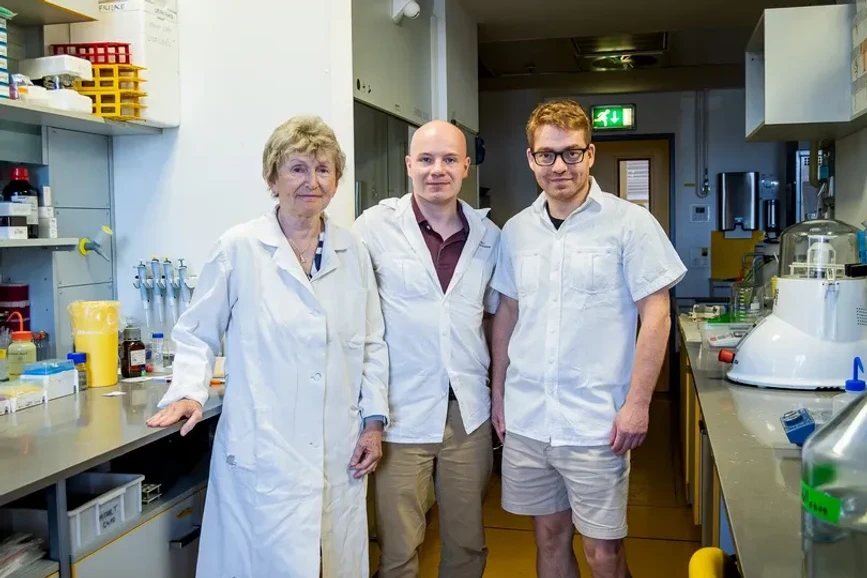 IOCHB Prague/Tomáš Belloň: A study in Nature sheds new light on DNA repair in early human embryos, with implications for future gene correction: First author of the study Štěpán Jeřábek (Columbia University) with co-authors Michal Doležal and Iva Pichová (IOCB Prague).
The original article
Highly efficient base editing at PCSK9 and normal human embryo development
Stepan Jerabek, Chanju Jung, Michelle Kappy, Qiaojin Zhao, Julie Sung, Ning Wang, Euihyun Kim, Jimin Kim, Marcos Iuri Roos Kulmann, Madeleine Bliss King, Mitchell John McAndrew, Meng Li, Sakshi Bhatele, Melisa Isado, Hong-Su Jang, Michal Dolezal, Robert Prosser, Shuangyi Xu, Gue-Ho Hwang, Iva Pichova, Jia Xu, Diego Marin, Jae-Sung Woo, Sangsu Bae, Nathan Treff, Audrone Lapinaite & Dieter Egli
Nature, 2026, doi: 10.1038/s41586-026-11118-x