Th, 8.10.2026 | Original article from: RECETOX-MUNI
EnzymeMiner 2.0 from the Loschmidt Laboratories searches vast protein sequence databases to identify promising enzymes and predict their properties before laboratory testing.Searches a billion proteins to find a custom enzyme. EnzymeMiner 2.0 will make work easier for scientists worldwide
RECETOX-MUNI: Searches a billion proteins to find a custom enzyme. EnzymeMiner 2.0 will make work easier for scientists worldwide
EnzymeMiner 2.0 was developed by scientists from the Loschmidt Laboratories to search through vast databases of protein sequences. An article about the web server, which could accelerate the engineering of enzymes in laboratories, was published by the Nucleic Acids Research journal.
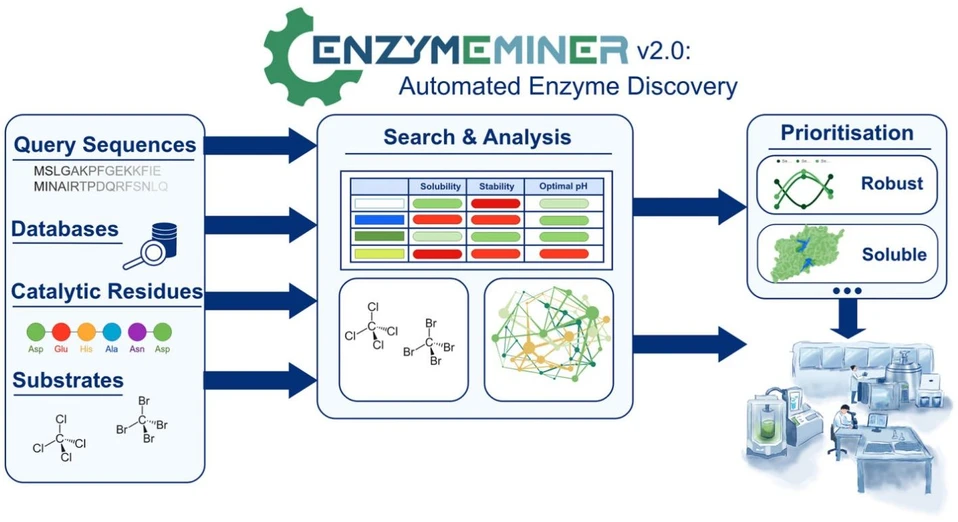
The open-access bioinformatics tool EnzymeMiner 2.0, developed at the Loschmidt Laboratories, scans extensive databases of natural enzymes. Based on specified parameters, it identifies those with the desired properties for industry, medicine, or environmental protection.
"Instead of spending years genetically modifying an enzyme in the lab, you can now ask if something better already exists in nature," says the article's lead author, PhD candidate Monika Rosinská. "Most proteins in public databases have never been studied. Nature may already contain the enzymes that industry needs. Finding these valuable enzymes among a billion sequences is difficult. And that is precisely what EnzymeMiner does," Rosinská explains.
EnzymeMiner 2.0 is free and runs online in a standard browser. The user simply pastes a known enzyme and specifies the functional requirements for the new target enzyme. For example, better stability or resistance to high industrial temperatures. Within a few hours, the system searches the databases, automatically filtering and ranking the most similar and suitable candidates.
In addition to larger databases and automated filtering, version 2.0 introduces several upgrades over the original variant. For instance, the server can now predict the properties and behaviour of an enzyme prior to laboratory testing.
Researchers from the Loschmidt Laboratories at the RECETOX Centre collaborated on the development alongside colleagues from the Faculty of Science at Masaryk University, the International Clinical Research Centre (ICRC) at St. Anne's University Hospital, and the Faculty of Information Technology at Brno University of Technology.
The study was supported by the EU Horizon 2020 program (grant agreement no. 857560 – CETOCOEN Excellence) and the Horizon Europe Framework (no. 101136607 – CLARA). Support was also provided by the Czech Science Foundation (no. 25-18233M). Monika Rosinská was supported by the Brno Ph.D. Talent scholarship, funded by the Statutory City of Brno. Computational resources were provided by e-INFRA CZ, ELIXIR-CZ, and RECETOX RI projects (90254, LM2023055, LM2023069), with support from MŠMT.
EnzymeMiner 2.0
RECETOX-MUNI: Searches a billion proteins to find a custom enzyme. EnzymeMiner 2.0 will make work easier for scientists worldwide
Article
EnzymeMiner 2.0: advancing automated enzyme discovery with expansive sequence mining and smart property analysis
Monika Rosinska, Lucie Svobodova, Simeon Borko, David Lacko, Joan Planas-Iglesias, Sérgio M Marques, Petr Kabourek, Baoyan Liu, Karen Pailozian, Jiri Damborsky, Stanislav Mazurenko, David Bednar
Nucleic Acids Res., 2026, 54, W257–W265
https://doi.org/10.1093/nar/gkag424
licenced under CC-BY 4.0
Abstract
Enhancing enzymes to improve desired properties remains an expensive and time-consuming process. Scanning databases of known protein sequences to find enzymes with similar catalytic activity and enhanced properties is an efficient and valuable approach. The EnzymeMiner web server has proven integral as an automated, user-friendly tool that identifies enzymes with the desired catalytic activity from provided sequences and essential residues. Here, we introduce EnzymeMiner 2.0 that builds upon its predecessor, retaining its original functionality, while introducing several key improvements: (i) significantly expanded searched protein space; (ii) annotation of discovered sequences with predictions of the melting temperature, optimal pH, catalytic activity and efficiency, and aggregation propensity with state-of-the-art computational tools; and (iii) smart automatic sequence prioritization and filtering based on user-defined goals or a set of predefined scenarios. With all these enhancements, EnzymeMiner 2.0 aims to remain among the leading solutions for efficient discovery of novel enzymes. The server is freely accessible at https://loschmidt.chemi.muni.cz/enzymeminer/.