Tu, 6.10.2026 | Original article from: Thermo Fisher Scientific / Petra Gerhards
Switching from helium to hydrogen in GC-MS/MS does not necessarily mean losing sensitivity. A study of 181 pesticides shows how method optimization can maintain reliable routine quantitation.Helium to Hydrogen: What Happens to GC-MS/MS Performance When You Switch Carrier Gas?
- Thermo Fisher Scientific: Helium to Hydrogen: What Happens to GC-MS/MS Performance When You Switch Carrier Gas?
- Video: Chromatography & Mass Spectrometry Solutions: TSQ 9610 Triple Quadrupole GCMSMS System
Helium has long been a preferred carrier gas for gas chromatography (GC), but availability, cost and supply considerations are prompting laboratories to look more closely at alternatives. Hydrogen is an attractive candidate: it is readily available from on-site generators and its chromatographic properties can enable efficient separations across a broad range of linear velocities.
 Thermo Fisher Scientific: Helium to Hydrogen: What Happens to GC-MS/MS Performance When You Switch Carrier Gas?
But for laboratories running sensitive GC-MS/MS applications, the important question is not simply whether hydrogen can move compounds through a GC column.
Can you switch from helium to hydrogen while maintaining the analytical performance required for routine quantitative analysis?
Experimental work evaluating pesticide residues provides useful insight into what laboratories should expect—and where method optimization may be required.
Why consider hydrogen as a GC carrier gas?
From a chromatography perspective, hydrogen offers several attractive properties. Its higher optimal linear velocity can support shorter separations while maintaining efficiency, and high efficiency can be maintained across a relatively broad linear-velocity range. Hydrogen can also be generated on site, reducing dependence on high-pressure helium cylinders.
The change, however, is not necessarily a simple gas-for-gas substitution.
Hydrogen is flammable and requires appropriate measures to minimize leaks and discharge into the laboratory environment. It is also a reactive gas, which means it can potentially alter chromatographic behavior or analyte response. Its low viscosity introduces additional considerations for GC-MS operation, including pumping requirements and inlet behavior.
For GC-MS/MS laboratories, another important consideration is what happens inside the mass spectrometer.
Does hydrogen change sensitivity?
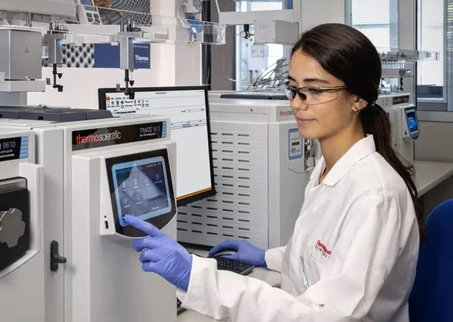
To investigate the practical impact of changing carrier gas, 181 GC-amenable pesticides were evaluated in baby food and honey matrices using a Thermo Scientific TSQ 9610 triple quadrupole GC-MS/MS system with the NeverVent Advanced Electron Ionization (AEI) ion source.
An initial comparison using the same conditions as the helium method showed that, after conditioning, sensitivity for most compounds was comparable and in some cases higher with hydrogen. The subsequent hydrogen method was optimized by limiting acquisition to two transitions, selecting alternative transitions where fragmentation differed significantly, and narrowing retention-time windows.
Across the evaluated compounds, 83% showed comparable or higher response with hydrogen. Approximately 15% showed a two- to three-fold lower response, while only 2% showed a response more than three times lower.
That result highlights an important point: moving to hydrogen does not necessarily mean accepting a universal loss in sensitivity. The effect is compound dependent—and understanding those individual differences is key to a successful method transition.
What happens to the mass spectrum?
This is where the helium-to-hydrogen transition becomes particularly interesting.
For some analytes, the presence of hydrogen affected the ionization process and produced differences in the full-scan spectrum. However, targeted pesticide-residue methods do not normally identify compounds solely by matching spectra against a library. Identification instead relies on parameters such as retention time and ion ratios between compound-specific transitions.
A useful example is Deltamethrin at 0.005 mg/kg in baby food.
Spectral comparison: helium versus hydrogen
The Deltamethrin comparison showed an impact on the spectra between the two carrier gases. With hydrogen, the monitored transitions produced S/N values of 67 and 70; with helium, the corresponding values were 51 and 42.
 Thermo Fisher Scientific: Helium to Hydrogen: What Happens to GC-MS/MS Performance When You Switch Carrier Gas?: Figure 1. Comparison of Deltamethrin at 0.005 mg/kg in baby food using helium and hydrogen carrier gases. In this example, changing carrier gas produced an impact on the spectrum but more sensitivity with hydrogen.
The picture was not identical for every analyte. Fluridone, for example, showed reduced response primarily for one transition with hydrogen, while isodrin showed higher response on both evaluated transitions. Other compounds exhibited changes in the relative responses of individual transitions.
These examples reinforce why existing MS/MS methods should be reviewed rather than simply transferred unchanged.
Method optimization matters
The hydrogen method was ultimately optimized to use 489 transitions with a 0.3-minute retention-time window, compared with 656 transitions and a 0.7-minute window for the helium method. The narrower acquisition windows and reduced number of transitions allowed longer dwell times.
This optimization helped deliver strong quantitative performance.
For the hydrogen method, 181 pesticides in baby food and honey could be quantified down to 5 ppb (0.005 mg/kg). Repeatability testing showed an RSD below 10% for 98% of compounds at 10 ppb and below 5% for 97% of compounds at 50 ppb.
The results suggest that the relevant question is therefore not “Does hydrogen behave exactly like helium?”
It does not always.
A more useful question is: “Can the method be adapted to accommodate those differences while maintaining the required analytical performance?”
For this study, the answer was yes.
Chromatography can benefit too
Hydrogen also influenced chromatographic retention without necessarily compromising peak width.
For example, chloroneb eluted at 8.09 minutes with hydrogen compared with 8.66 minutes with helium, while both conditions produced a peak width of 0.03 minutes measured at 10% height.
Similar behavior was observed for later-eluting compounds. Fenthion eluted at 11.23 minutes with hydrogen versus 12.46 minutes with helium, while ethion shifted from 16.10 minutes with helium to 14.44 minutes with hydrogen.
These results illustrate one of hydrogen’s potential advantages: laboratories may be able to exploit its chromatographic properties as part of method optimization rather than simply attempting to reproduce a helium method exactly.
So, can your laboratory make the switch?
The experimental results demonstrate that hydrogen can be a practical carrier gas for demanding GC-MS/MS applications—but successful implementation requires more than changing the gas supply.
Laboratories should evaluate chromatographic conditions, MS/MS transitions, ion ratios, background, sensitivity and quantitative performance for their particular analytes and matrices. Some compounds may require different transitions or additional optimization because hydrogen can influence ionization and fragmentation behavior.
At the same time, the results from this 181-pesticide evaluation show that those differences do not automatically translate into compromised method performance.
With an optimized method, all 181 evaluated pesticides could be quantified at 5 ppb, while the large majority of compounds delivered comparable or higher response relative to helium.
For laboratories facing helium supply or cost pressures, that makes hydrogen more than simply an emergency substitute. With appropriate method evaluation and optimization, it can be a viable carrier gas for routine GC-MS/MS analysis.
Key takeaway
Switching from helium to hydrogen should be treated as a method transition, not merely a carrier-gas replacement. Evaluate the compounds that behave differently, optimize transitions and acquisition parameters where needed, and verify performance against the requirements of your application.
The resulting method may look slightly different—but the analytical performance does not necessarily have to.
References
- Application note: Empowering routine pesticide residue analysis in food with a GC-MS/MS platform using hydrogen as the carrier gas
- Watch this webinar on demand: Journey through time in Pesticides analysis
- Visit us on LinkedIn: #GCMSMS #HydrogenCarrierGas #PesticideAnalysis #FoodSafety