Tu, 14.4.2026 | Original article from: Thermo Fisher Scientific / Petra Gerhards
How GC-MS resolution shapes data interpretation: single quadrupole vs. HRAM illustrated through blue fenugreek volatile analysis.When Resolution Changes the Story: Single Quadrupole vs. HRAM GC-MS
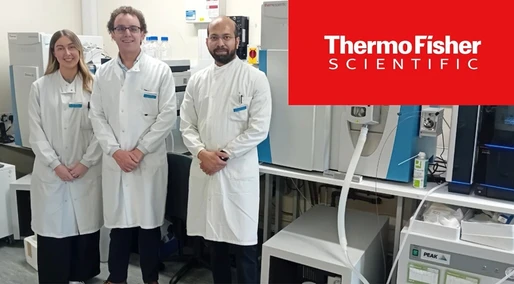
- Photo: Thermo Fisher Scientific: When Resolution Changes the Story: Single Quadrupole vs. HRAM GC-MS
- Video: Chromatography & Mass Spectrometry Solutions: Thermo Scientific Orbitrap Exploris GC Mass Spectrometer
In analytical chemistry, there are moments when your instrument gives you an answer, and moments when it gives you a question. The difference often comes down to resolution.
A compelling example can be found in the analysis of blue fenugreek (Trigonella caerulea), a plant that is widely used as a spice in traditional foods. Interestingly, the fresh plant has almost no aroma, yet after drying and storage it develops a rich and complex bouquet. Understanding this transformation requires detailed insight into a highly dynamic mixture of volatile compounds.
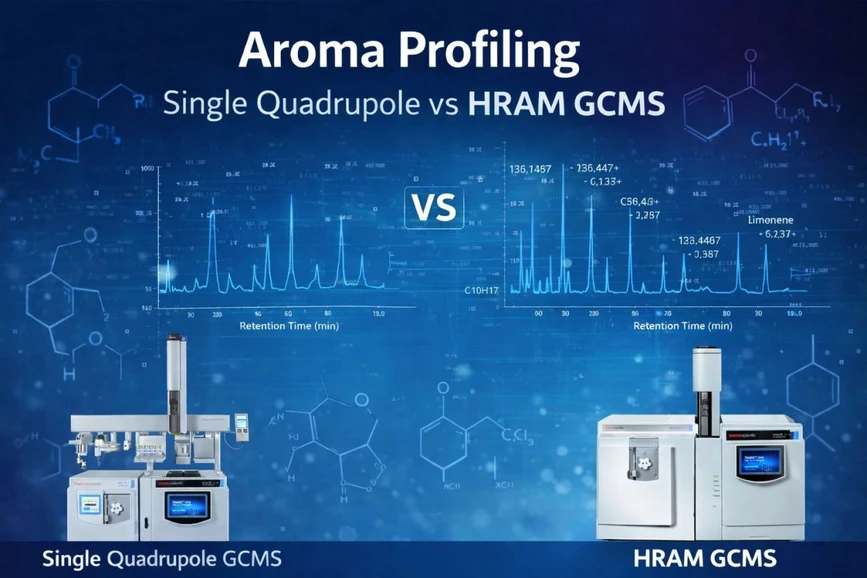 Thermo Fisher Scientific: When Resolution Changes the Story: Single Quadrupole vs. HRAM GC-MS
When researchers investigated this system using GC-MS, they encountered exactly the kind of analytical ambiguity that many of us are familiar with. The sample contained a complex mixture of aldehydes and monoterpenoids, along with compounds that were not well described in existing databases.
At first glance, a single quadrupole GC-MS appears to be perfectly suited for this type of analysis. It is robust, widely available, and highly effective for routine workflows. It provides reproducible fragmentation patterns and enables reliable library matching. In many cases, this is entirely sufficient.
However, challenges arise when compounds share very similar fragmentation behavior. In the case of blue fenugreek, one particular signal could be interpreted in more than one way. The data were consistent with either dimethyl sulfide or a sulfine-type compound. Both possibilities made chemical sense, and both could be supported by the spectra obtained on a quadrupole system.
This situation illustrates a fundamental limitation of unit mass resolution. When two candidate structures produce nearly indistinguishable spectra, the instrument cannot decisively distinguish between them. The result is not an incorrect answer, but an incomplete one. You are left with a hypothesis rather than a conclusion.
The picture changes significantly when high-resolution accurate mass (HRAM) GC-MS is introduced. Instruments such as Orbitrap-based systems provide exact mass measurements with very high accuracy. This allows the determination of elemental compositions and enables clear differentiation between compounds that differ only slightly in mass.
In the same example, HRAM analysis made it possible to distinguish between the competing structural hypotheses. What previously appeared ambiguous could now be resolved with confidence.
This improvement is not merely a technical detail. It has important consequences for how the data are interpreted. Correct compound identification directly affects our understanding of biochemical pathways, especially in systems where aroma compounds are formed during drying and storage. It also influences how we assign sensory properties, since even small structural differences can lead to significant changes in odor perception. Furthermore, when studying the dynamics of volatile compounds over time, precise identification becomes essential for tracking formation and degradation processes.
Despite these advantages, it would be misleading to suggest that HRAM GC-MS should replace single quadrupole systems in all cases. Single quadrupole instruments remain indispensable for routine analysis, targeted workflows, and situations where compounds are well known and thoroughly characterized. They offer a practical balance of performance, cost, and throughput.
The key distinction lies in the analytical question being asked. If the goal is to quantify known compounds in a reliable and efficient manner, a single quadrupole system is often entirely appropriate. If, however, the goal is to identify unknowns, resolve ambiguities, or explore complex and poorly understood systems, then high-resolution accurate mass becomes essential.
The study of blue fenugreek highlights a broader lesson. Natural products often present us with chemical complexity that challenges our assumptions and our tools. In such cases, ambiguity in the data is not a failure, but an indication that a deeper level of analysis is required.
Ultimately, resolution is more than just an instrument specification. It defines how confidently we can translate signals into knowledge.
Acknowledgement:
I would like to thank Dr. Thomas Stegemann, Lab Manager and group leader, Christian-Alberts-University, Kiel, for the contribution to this blog.
Call to action:
- Watch webinar on demand: Aromatic profiling using GCMS and HRGCMS
- Visit us on LinkedIn: #GCMS #MassSpectrometry #HRAM #Orbitrap
Petra Gerhards
Regional Marketing Manager GC and GC/MS, EMEA, Thermo Fisher Scientific