The Nobel Prize in Chemistry 2025 (live)

We, 8.10.2025 | Original article from: NobelPrize.org. Nobel Prize Outreach 2025
The Royal Swedish Academy of Sciences has decided to award the Nobel Prize in Chemistry 2025 to Susumu Kitagawa, Richard Robson, Omar M. Yaghi for the development of metal-organic frameworks.
  • Photo: NobelPrize.org: The Nobel Prize in Chemistry 2025
  • Video: Nobel Prize: Announcement of the 2025 Nobel Prize in Chemistry

The Royal Swedish Academy of Sciences has decided to award the Nobel Prize in Chemistry 2025 to

Susumu Kitagawa, born 1951 in Kyoto, Japan. PhD 1979 from Kyoto University, Japan. Professor at Kyoto University, Japan.

Richard Robson, born 1937 in Glusburn, UK. PhD 1962 from University of Oxford, UK. Professor at University of Melbourne, Australia.

Omar M. Yaghi, Born 1965 in Amman, Jordan. PhD 1990 from University of Illinois Urbana-Champaign, USA. Professor at University of California, Berkeley, USA.

“for the development of metal-organic frameworks”

The Royal Swedish Academy of Sciences / Ill. Niklas Elmehed © Nobel Prize OutreachThe Royal Swedish Academy of Sciences / Ill. Niklas Elmehed © Nobel Prize Outreach

Their molecular architecture contains rooms for chemistry

The Nobel Prize laureates in chemistry 2025 have created molecular constructions with large spaces through which gases and other chemicals can flow. These constructions, metal-organic frameworks, can be used to harvest water from desert air, capture carbon dioxide, store toxic gases or catalyse chemical reactions.
©Johan Jarnestad / The Royal Swedish Academy of Sciences©Johan Jarnestad / The Royal Swedish Academy of Sciences

Susumu Kitagawa, Richard Robson and Omar Yaghi are awarded the Nobel Prize in Chemistry 2025. They have developed a new form of molecular architecture. In their constructions, metal ions function as cornerstones that are linked by long organic (carbon-based) molecules. Together, the metal ions and molecules are organised to form crystals that contain large cavities. These porous materials are called metal-organic frameworks (MOF). By varying the building blocks used in the MOFs, chemists can design them to capture and store specific substances. MOFs can also drive chemical reactions or conduct electricity.
©Johan Jarnestad / The Royal Swedish Academy of Sciences©Johan Jarnestad / The Royal Swedish Academy of Sciences

“Metal-organic frameworks have enormous potential, bringing previously unforeseen opportunities for custom-made materials with new functions,” says Heiner Linke, Chair of the Nobel Committee for Chemistry.
©Johan Jarnestad / The Royal Swedish Academy of Sciences©Johan Jarnestad / The Royal Swedish Academy of Sciences

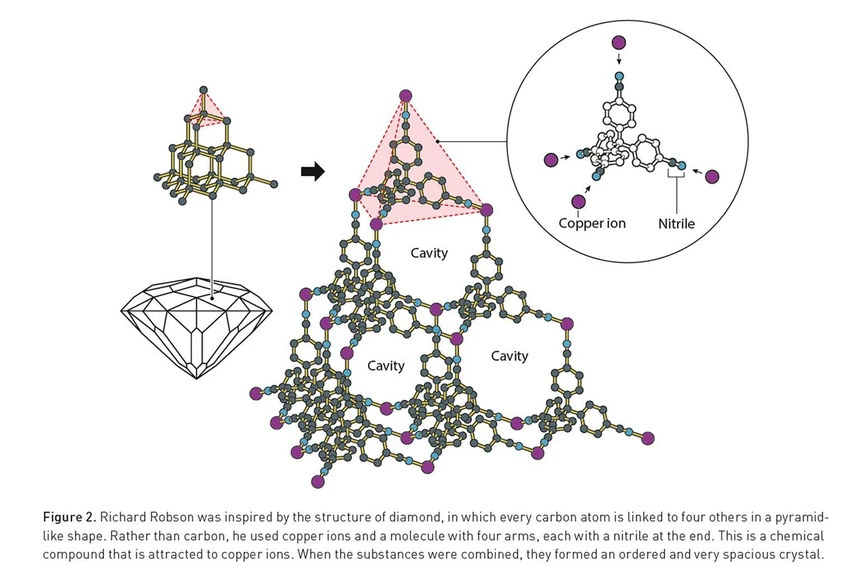
It all started in 1989, when Richard Robson tested utilising the inherent properties of atoms in a new way. He combined positively charged copper ions with a four-armed molecule; this had a chemical group that was attracted to copper ions at the end of each arm.
©Johan Jarnestad / The Royal Swedish Academy of Sciences©Johan Jarnestad / The Royal Swedish Academy of Sciences

When they were combined, they bonded to form a well-ordered, spacious crystal. It was like a diamond filled with innumerable cavities.

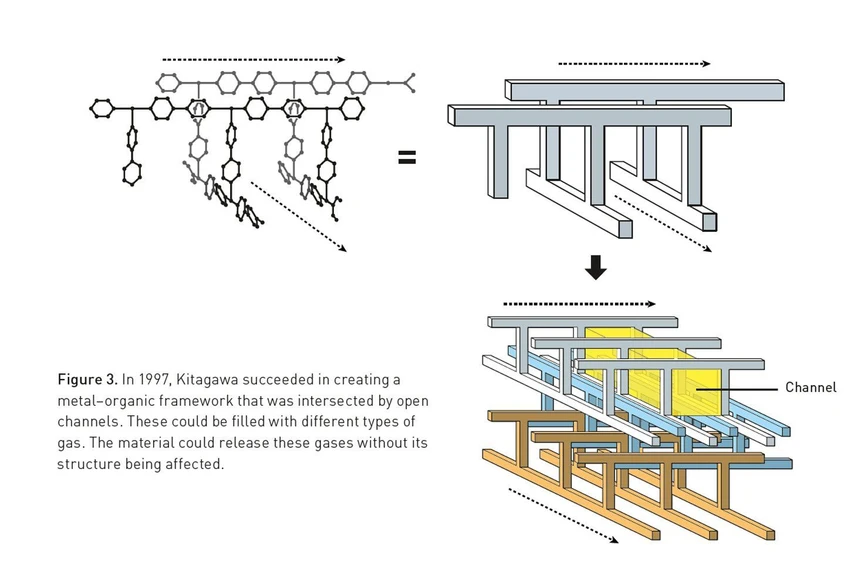
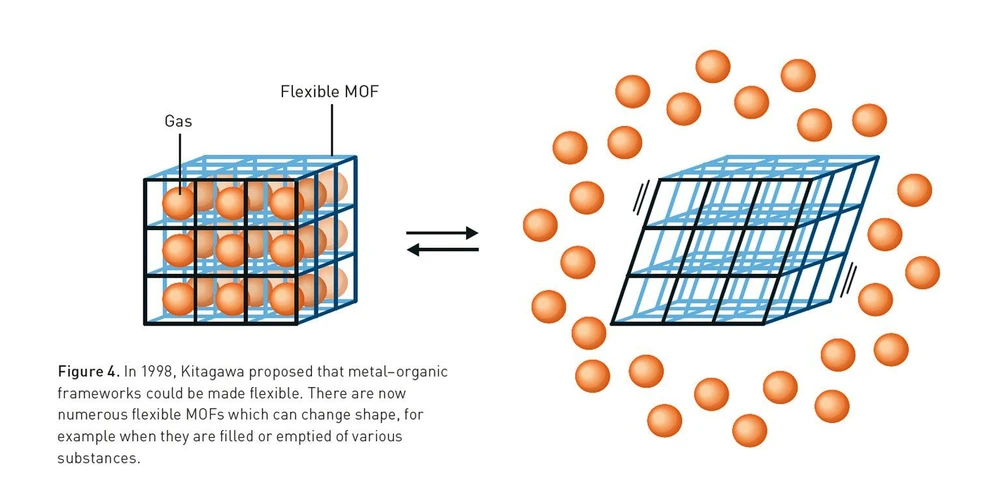
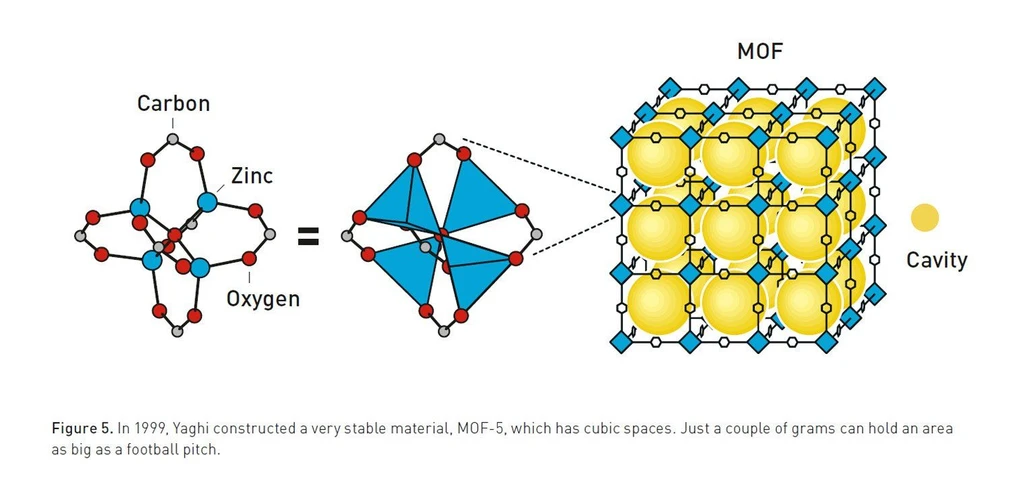
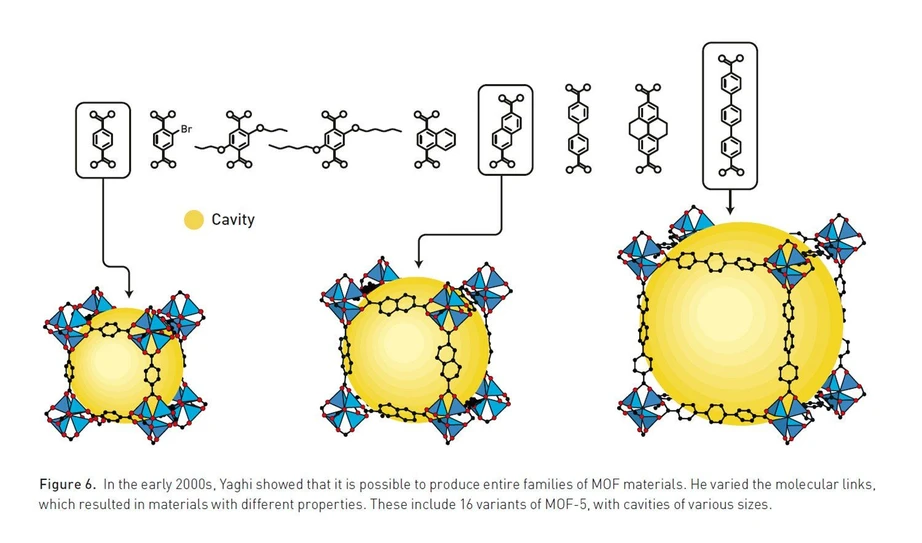
Robson immediately recognised the potential of his molecular construction, but it was unstable and collapsed easily. However, Susumu Kitagawa and Omar Yaghi provided this building method with a firm foundation; between 1992 and 2003 they made, separately, a series of revolutionary discoveries. Kitagawa showed that gases can flow in and out of the constructions and predicted that MOFs could be made flexible. Yaghi created a very stable MOF and showed that it can be modified using rational design, giving it new and desirable properties.
©Johan Jarnestad / The Royal Swedish Academy of Sciences©Johan Jarnestad / The Royal Swedish Academy of Sciences

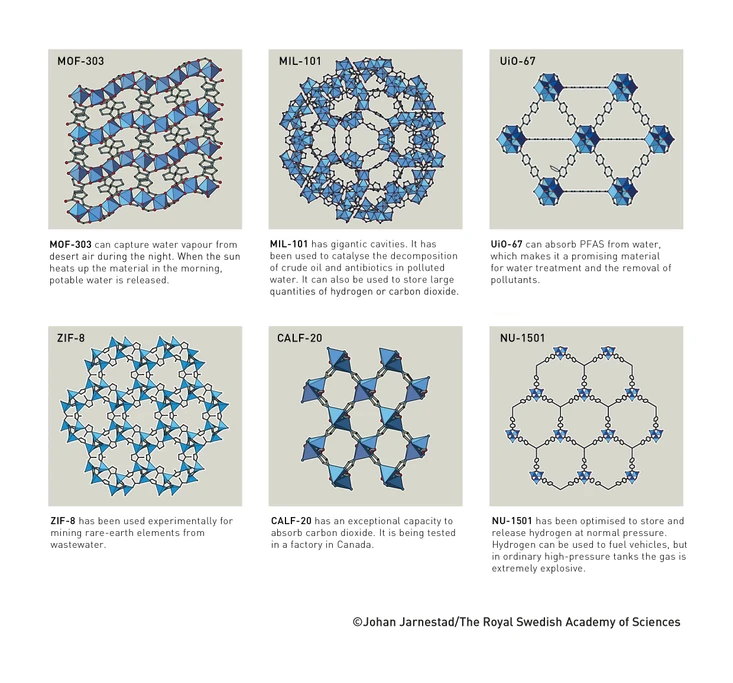
Following the laureates’ groundbreaking discoveries, chemists have built tens of thousands of different MOFs. Some of these may contribute to solving some of humankind’s greatest challenges, with applications that include separating PFAS from water, breaking down traces of pharmaceuticals in the environment, capturing carbon dioxide or harvesting water from desert air.
©Johan Jarnestad / The Royal Swedish Academy of Sciences©Johan Jarnestad / The Royal Swedish Academy of Sciences

Read more about this year’s prize

Prize amount: 11 million Swedish kronor to be shared equally between the laureates
Further information: www.kva.se and www.nobelprize.org
Press contact: Eva Nevelius, Press Secretary, +46 70 878 67 63, [email protected]
Expert: Olof Ramström, +46 70 433 42 60, [email protected], member of the Nobel Committee for Chemistry

The Royal Swedish Academy of Sciences, founded in 1739, is an independent organisation whose overall objective is to promote the sciences and strengthen their influence in society. The Academy takes special responsibility for the natural sciences and mathematics, but endeavours to promote the exchange of ideas between various disciplines.

The Royal Swedish Academy of Sciences
LinkedIn Logo
 

Related articles

ESAS 2022 & 17th CSSC (Speakers + Lecture/Poster deadline)
Article | Events

ESAS 2022 & 17th CSSC (Speakers + Lecture/Poster deadline)

Who will be speakers at this year's European Symposium on Analytical Spectrometry (ESAS) and the 17th Czech-Slovak Spectroscopic Conference (CSSC)?
Researchers at IOCB Prague predict a new physical phenomenon through advanced molecular modeling
Article | Science and research

Researchers at IOCB Prague predict a new physical phenomenon through advanced molecular modeling

A team at IOCB Prague revealed a novel phase where liquids flip rapidly between metal and nonmetal states. The theory, based on advanced modeling, was featured in Nature Communications.
ISC 2026 Keynote Lectures
Article | Events

ISC 2026 Keynote Lectures

ISC 2026 will feature 32 world-renowned keynote speakers covering chromatography, mass spectrometry, metabolomics, proteomics, omics sciences, microfluidics, and advanced separation technologies.
CEITEC Technology Will Help Reveal How Oxygen Controls Embryo Development
Article | Science and research

CEITEC Technology Will Help Reveal How Oxygen Controls Embryo Development

Scientists from CEITEC Brno University of Technology have won a prestigious HFSP grant to study how oxygen levels influence early embryo development using a unique technology.
 

Related articles

ESAS 2022 & 17th CSSC (Speakers + Lecture/Poster deadline)
Article | Events

ESAS 2022 & 17th CSSC (Speakers + Lecture/Poster deadline)

Who will be speakers at this year's European Symposium on Analytical Spectrometry (ESAS) and the 17th Czech-Slovak Spectroscopic Conference (CSSC)?
Researchers at IOCB Prague predict a new physical phenomenon through advanced molecular modeling
Article | Science and research

Researchers at IOCB Prague predict a new physical phenomenon through advanced molecular modeling

A team at IOCB Prague revealed a novel phase where liquids flip rapidly between metal and nonmetal states. The theory, based on advanced modeling, was featured in Nature Communications.
ISC 2026 Keynote Lectures
Article | Events

ISC 2026 Keynote Lectures

ISC 2026 will feature 32 world-renowned keynote speakers covering chromatography, mass spectrometry, metabolomics, proteomics, omics sciences, microfluidics, and advanced separation technologies.
CEITEC Technology Will Help Reveal How Oxygen Controls Embryo Development
Article | Science and research

CEITEC Technology Will Help Reveal How Oxygen Controls Embryo Development

Scientists from CEITEC Brno University of Technology have won a prestigious HFSP grant to study how oxygen levels influence early embryo development using a unique technology.
 

Related articles

ESAS 2022 & 17th CSSC (Speakers + Lecture/Poster deadline)
Article | Events

ESAS 2022 & 17th CSSC (Speakers + Lecture/Poster deadline)

Who will be speakers at this year's European Symposium on Analytical Spectrometry (ESAS) and the 17th Czech-Slovak Spectroscopic Conference (CSSC)?
Researchers at IOCB Prague predict a new physical phenomenon through advanced molecular modeling
Article | Science and research

Researchers at IOCB Prague predict a new physical phenomenon through advanced molecular modeling

A team at IOCB Prague revealed a novel phase where liquids flip rapidly between metal and nonmetal states. The theory, based on advanced modeling, was featured in Nature Communications.
ISC 2026 Keynote Lectures
Article | Events

ISC 2026 Keynote Lectures

ISC 2026 will feature 32 world-renowned keynote speakers covering chromatography, mass spectrometry, metabolomics, proteomics, omics sciences, microfluidics, and advanced separation technologies.
CEITEC Technology Will Help Reveal How Oxygen Controls Embryo Development
Article | Science and research

CEITEC Technology Will Help Reveal How Oxygen Controls Embryo Development

Scientists from CEITEC Brno University of Technology have won a prestigious HFSP grant to study how oxygen levels influence early embryo development using a unique technology.
 

Related articles

ESAS 2022 & 17th CSSC (Speakers + Lecture/Poster deadline)
Article | Events

ESAS 2022 & 17th CSSC (Speakers + Lecture/Poster deadline)

Who will be speakers at this year's European Symposium on Analytical Spectrometry (ESAS) and the 17th Czech-Slovak Spectroscopic Conference (CSSC)?
Researchers at IOCB Prague predict a new physical phenomenon through advanced molecular modeling
Article | Science and research

Researchers at IOCB Prague predict a new physical phenomenon through advanced molecular modeling

A team at IOCB Prague revealed a novel phase where liquids flip rapidly between metal and nonmetal states. The theory, based on advanced modeling, was featured in Nature Communications.
ISC 2026 Keynote Lectures
Article | Events

ISC 2026 Keynote Lectures

ISC 2026 will feature 32 world-renowned keynote speakers covering chromatography, mass spectrometry, metabolomics, proteomics, omics sciences, microfluidics, and advanced separation technologies.
CEITEC Technology Will Help Reveal How Oxygen Controls Embryo Development
Article | Science and research

CEITEC Technology Will Help Reveal How Oxygen Controls Embryo Development

Scientists from CEITEC Brno University of Technology have won a prestigious HFSP grant to study how oxygen levels influence early embryo development using a unique technology.