Scientists from IOCB Prague are on track of finding a treatment for alopecia

Th, 13.3.2025 | Original article from: IOCB
The scientific team of Dr. Pavel Majer from the IOCB of the CAS has developed a new substance with the potential to treat the autoimmune disease alopecia areata, which is manifested by hair loss.
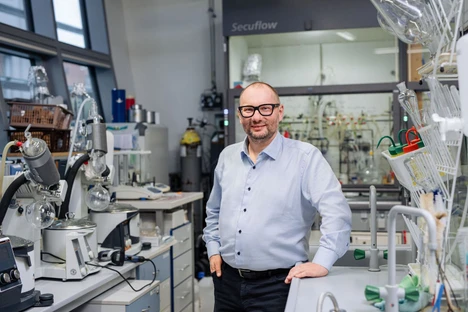
  • Photo: IOCB Prague / Dr. Tomáš Belloň: Dr. Pavel Majer, head of the Drug Discovery group, IOCB Prague
  • Video: IOCB Prague: Scientists from IOCB Prague are on track of finding a treatment for autoimmune hair loss

A research group, led by Dr. Pavel Majer from IOCB Prague, in collaboration with the laboratories of Barbara Slusher and Louis Garza at Johns Hopkins University, have developed a compound that could potentially treat the autoimmune disorder alopecia areata, which causes hair loss leading to the formation of bald patches. The results of their study, recently published in the Journal of Medicinal Chemistry, confirm the efficacy of a series of prodrugs based on derivatives of itaconic acid, simply referred to as itaconates. What is more, there is a good chance that the substances will be administrable orally in the form of tablets and not just as an ointment.

IOCB Prague / Dr. Tomáš Belloň: Dr. Pavel Majer, head of the Drug Discovery group, IOCB PragueIOCB Prague / Dr. Tomáš Belloň: Dr. Pavel Majer, head of the Drug Discovery group, IOCB Prague

Itaconate is a naturally occurring substance with anti-inflammatory effects elicited by interacting with the immune system. However, itaconate has the weakness that it does not easily penetrate the cells. The team of Pavel Majer, which has spent several years developing a drug for alopecia, has surmounted this obstacle by developing prodrugs, compounds that convert into the active drug only within the body.

We have prepared a series of prodrugs, at least two of which appear to be highly effective. Tests on mice have confirmed that the compounds are absorbed well and release the active ingredient in the skin at the right concentration. Our itaconate derivatives could thus represent a completely new method of treating alopecia,” says Pavel Majer, head of the Drug Discovery group at IOCB Prague.

PNAS Nexus 2023, 2 (1), pgac297 DOI: 10.1093/pnasnexus/pgac297): The compound SCD-153 accelerates the regrowth of mouse fur compared to control experiments using a solvent and 4-methyl itaconatePNAS Nexus 2023, 2 (1), pgac297 DOI: 10.1093/pnasnexus/pgac297): The compound SCD-153 accelerates the regrowth of mouse fur compared to control experiments using a solvent and 4-methyl itaconate

Alopecia areata is an autoimmune disorder in which the immune system attacks hair follicles, leading to their inflammation and consequently to hair loss and impaired hair growth. The condition affects about 2% of people, mostly women, and is the second most common cause of hair loss, after androgenetic alopecia (pattern baldness). Current treatments are predominantly based on corticosteroids, which come with a number of side effects.

The scientists have proved that the new substances could bring significant relief to patients with alopecia areata. The current article builds on an earlier study by these groups, published in 2022 by the journal PNAS Nexus. The considerable potential of this discovery has also been recognized by the pharmaceutical company SPARC, which has purchased a licence for the patented technology utilizing itaconate prodrugs. One of the compounds developed, SCD-153, when applied as an ointment, relieves inflammation, protects hair follicles and, according to previous tests on mice, accelerates the growth of new hair. It does so by making hair follicles transition from a dormant state to an active one. SPARC has already started hiring patients for phase 1 clinical trial on this promising compound.

Resources

Lee, C. B., Šnajdr, I., Tenora, L., Alt, J., Gori, S., Krečmerová, M., Maragakis, R. M., Paule, J., Tiwari, S., Iyer, J., Talwar, R., Garza, L., Majer, P., Slusher, B. S., & Rais, R. Discovery of Orally Available Prodrugs of Itaconate and Derivatives. J. Med. Chem. 2025, 68 (3), 3433–3444. https://pubs.acs.org/doi/full/10.1021/acs.jmedchem.4c02646
Institute of Organic Chemistry and Biochemistry of the Czech Academy of Sciences
LinkedIn Logo
 

Related articles

New Czech company linked to IOCB Prague to enter global gene therapy field
Article | Video

New Czech company linked to IOCB Prague to enter global gene therapy field

Technology from the laboratories of IOCB Prague has been given an extraordinary opportunity to succeed in the rapidly developing segment of gene therapy.
Researchers tame a deadly fungus that threatens immunocompromised patients
Article | Science and research

Researchers tame a deadly fungus that threatens immunocompromised patients

A team led by Prof. Jan Konvalinka has developed a compound that destroys the yeast Cryptococcus neoformans – a fungus which is life-threatening for people with weakened immune systems – in laboratory settings.
Petr Cígler receives the Rudolf Lukeš Prize, one of the country’s highest honors in chemistry
Article | Scientists

Petr Cígler receives the Rudolf Lukeš Prize, one of the country’s highest honors in chemistry

Dr. Petr Cígler receives the Rudolf Lukeš Prize 2025 for groundbreaking lipid and diamond nanoparticles that advance gene therapy, cancer treatment, imaging, and modern vaccine development.
Vobořil: There is still much to learn about the immune system
Article | Scientists

Vobořil: There is still much to learn about the immune system

After returning from the US, immunologist Matouš Vobořil joined Charles University to study immune cell development in the thymus and mechanisms linked to autoimmune diseases.
 

Related articles

New Czech company linked to IOCB Prague to enter global gene therapy field
Article | Video

New Czech company linked to IOCB Prague to enter global gene therapy field

Technology from the laboratories of IOCB Prague has been given an extraordinary opportunity to succeed in the rapidly developing segment of gene therapy.
Researchers tame a deadly fungus that threatens immunocompromised patients
Article | Science and research

Researchers tame a deadly fungus that threatens immunocompromised patients

A team led by Prof. Jan Konvalinka has developed a compound that destroys the yeast Cryptococcus neoformans – a fungus which is life-threatening for people with weakened immune systems – in laboratory settings.
Petr Cígler receives the Rudolf Lukeš Prize, one of the country’s highest honors in chemistry
Article | Scientists

Petr Cígler receives the Rudolf Lukeš Prize, one of the country’s highest honors in chemistry

Dr. Petr Cígler receives the Rudolf Lukeš Prize 2025 for groundbreaking lipid and diamond nanoparticles that advance gene therapy, cancer treatment, imaging, and modern vaccine development.
Vobořil: There is still much to learn about the immune system
Article | Scientists

Vobořil: There is still much to learn about the immune system

After returning from the US, immunologist Matouš Vobořil joined Charles University to study immune cell development in the thymus and mechanisms linked to autoimmune diseases.
 

Related articles

New Czech company linked to IOCB Prague to enter global gene therapy field
Article | Video

New Czech company linked to IOCB Prague to enter global gene therapy field

Technology from the laboratories of IOCB Prague has been given an extraordinary opportunity to succeed in the rapidly developing segment of gene therapy.
Researchers tame a deadly fungus that threatens immunocompromised patients
Article | Science and research

Researchers tame a deadly fungus that threatens immunocompromised patients

A team led by Prof. Jan Konvalinka has developed a compound that destroys the yeast Cryptococcus neoformans – a fungus which is life-threatening for people with weakened immune systems – in laboratory settings.
Petr Cígler receives the Rudolf Lukeš Prize, one of the country’s highest honors in chemistry
Article | Scientists

Petr Cígler receives the Rudolf Lukeš Prize, one of the country’s highest honors in chemistry

Dr. Petr Cígler receives the Rudolf Lukeš Prize 2025 for groundbreaking lipid and diamond nanoparticles that advance gene therapy, cancer treatment, imaging, and modern vaccine development.
Vobořil: There is still much to learn about the immune system
Article | Scientists

Vobořil: There is still much to learn about the immune system

After returning from the US, immunologist Matouš Vobořil joined Charles University to study immune cell development in the thymus and mechanisms linked to autoimmune diseases.
 

Related articles

New Czech company linked to IOCB Prague to enter global gene therapy field
Article | Video

New Czech company linked to IOCB Prague to enter global gene therapy field

Technology from the laboratories of IOCB Prague has been given an extraordinary opportunity to succeed in the rapidly developing segment of gene therapy.
Researchers tame a deadly fungus that threatens immunocompromised patients
Article | Science and research

Researchers tame a deadly fungus that threatens immunocompromised patients

A team led by Prof. Jan Konvalinka has developed a compound that destroys the yeast Cryptococcus neoformans – a fungus which is life-threatening for people with weakened immune systems – in laboratory settings.
Petr Cígler receives the Rudolf Lukeš Prize, one of the country’s highest honors in chemistry
Article | Scientists

Petr Cígler receives the Rudolf Lukeš Prize, one of the country’s highest honors in chemistry

Dr. Petr Cígler receives the Rudolf Lukeš Prize 2025 for groundbreaking lipid and diamond nanoparticles that advance gene therapy, cancer treatment, imaging, and modern vaccine development.
Vobořil: There is still much to learn about the immune system
Article | Scientists

Vobořil: There is still much to learn about the immune system

After returning from the US, immunologist Matouš Vobořil joined Charles University to study immune cell development in the thymus and mechanisms linked to autoimmune diseases.