Optimizing Fragment-Based Drug Discovery by NMR: A Deep Dive into Mnova Screening Software Solutions

We, 5.3.2025 | Original article from: Mestrelab Research
Fragment-Based Drug Discovery (FBDD) using NMR is a key method in early drug development. This post explores analytical techniques and software for precise screening and candidate identification.
<p><strong>Photo:</strong> Mestrelab Research: Optimizing Fragment-Based Drug Discovery by NMR: A Deep Dive into Mnova Screening Software Solutions</p>

Photo: Mestrelab Research: Optimizing Fragment-Based Drug Discovery by NMR: A Deep Dive into Mnova Screening Software Solutions

Fragment-Based Drug Discovery (FBDD) and validation of small molecules binders using NMR has emerged as a powerful method in early-stage drug development. This post explores the general use of analytical techniques and innovative screening software solutions that optimize the process, enabling researchers to identify promising drug candidates with precision.

Analytical Techniques in Fragment-Based Drug Discovery

To kickstart the FBDD journey, researchers employ ligand- or protein-observed NMR methods to detect binders from a library of small compounds. These analytical techniques, such as Nuclear Magnetic Resonance (NMR) spectroscopy, provide valuable data that play a crucial role in structurally characterizing potential drug molecules.

Efficient Screening Tools for Hit Finding

In the field of FBDD, researchers can benefit from a suite of powerful screening tools, including Mnova Screen 1D and Mnova Screen 2D, designed to efficiently analyze both 1D and 2D NMR data. These tools facilitate the analysis of 1D 1H or 19F screening data, including STD, T1ρ, WaterLogsy, and CPMG methods. Additionally, they allow batch processing of protein-observed 2D NMR spectra, such as 1H-15N or 1H-13C SOFAST HMQC. Automated peak picking and Q-Score ranking significantly expedite the identification and ranking of potential binding hits, empowering researchers to make data-driven decisions.

Measuring Binding Affinities with Precision

For researchers exploring multiple titration series, another piece of software, Mnova Binding, offers seamless batch processing of 2D NMR titration data. By fitting chemical shift perturbations (CSP) along titration curves, this tool accurately measures binding affinities (KD). Additionally, it automatically selects and averages individual KD values, facilitating comprehensive analysis.

Unified Software Solutions for FBDD

As illustrated in Fig 1, by presenting these software solutions, including Mnova Screen 1D, Mnova Screen 2D, and Mnova Binding, in a cohesive manner, researchers can benefit from a comprehensive toolbox with the same user-friendly interface to maximize the impact of NMR data, paving the way for innovative drug discoveries.

Mestrelab Research:Figure 1. Illustration of fragment-based drug discovery using 1D or 2D NMR, and the Mnova software tools for analyzing such data: Screen for 1D ligand-observed data such as STD, T1r, WaterLogsy and CPMG; Screen 2D for 2D protein-observed data such 1H-15N or 1H-13C SOFAST HMQC; Binding for titration series using 2D 1H-15N, 1H-13C, or 1H-13C/15N dual SOFAST-HMQC etc.Mestrelab Research:Figure 1. Illustration of fragment-based drug discovery using 1D or 2D NMR, and the Mnova software tools for analyzing such data: Screen for 1D ligand-observed data such as STD, T1r, WaterLogsy and CPMG; Screen 2D for 2D protein-observed data such 1H-15N or 1H-13C SOFAST HMQC; Binding for titration series using 2D 1H-15N, 1H-13C, or 1H-13C/15N dual SOFAST-HMQC etc.

Conclusion

In conclusion, this post highlights the significance of Innovative screening software solutions in advancing Fragment-Based Drug Discovery by NMR. By exploring the power of these screening tools, researchers gain a deeper understanding of potential drug molecules, accelerating the drug development process. Let’s embrace the potential of software solutions to revolutionize FBDD by NMR, uncovering new therapeutic possibilities for the future.

Contact us if you would like to talk to one of our experts about these NMR screening tools.

You can also watch a demonstration of a related application in one of our webinars held in October 2023. “Efficiently Driving Protein-based NMR Fragment Screening and Lead Discovery

SciY/Mestrelab Research
LinkedIn Logo
 

Related articles

Progress, Challenges and Opportunities of NMR and XL-MS for Cellular Structural Biology
Article | Scientific article

Progress, Challenges and Opportunities of NMR and XL-MS for Cellular Structural Biology

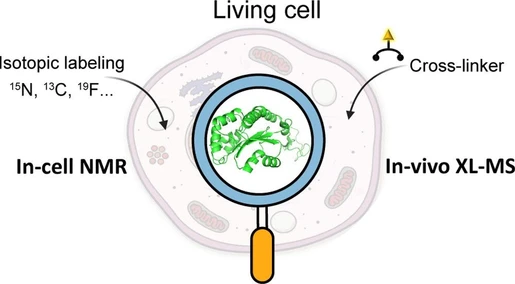
In the article in the JACS Au, the researchers summarized the recent advancements in in-cell nuclear magnetic resonance (NMR) and in vivo cross-linking mass spectrometry (XL-MS) for studying protein structures.
Determination of the pKa and Concentration of NMR-Invisible Molecules and Sites Using NMR Spectroscopy
Scientific article | Various

Determination of the pKa and Concentration of NMR-Invisible Molecules and Sites Using NMR Spectroscopy

The goal of this study is to develop a novel NMR-based method for determining pKa values and acidic species concentrations without direct observation.
Affinity Screen: Screening libraries within minutes made possible
Article | Product

Affinity Screen: Screening libraries within minutes made possible

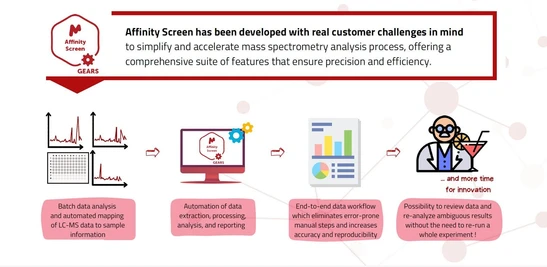
Discover how automated tools like Affinity Screen simplify AS-MS data analysis, speeding up drug discovery and development.
Residue-Level Determination of Small-Molecule–Protein Affinities by Hydrogen–Deuterium Exchange Mass Spectrometry
Scientific article | Science and research

Residue-Level Determination of Small-Molecule–Protein Affinities by Hydrogen–Deuterium Exchange Mass Spectrometry

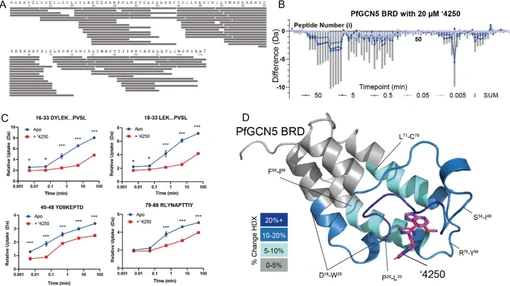
This study introduces an HDX-MS titration workflow for quantifying protein–ligand affinities at global, peptide, and residue resolution.
 

Related articles

Progress, Challenges and Opportunities of NMR and XL-MS for Cellular Structural Biology
Article | Scientific article

Progress, Challenges and Opportunities of NMR and XL-MS for Cellular Structural Biology

In the article in the JACS Au, the researchers summarized the recent advancements in in-cell nuclear magnetic resonance (NMR) and in vivo cross-linking mass spectrometry (XL-MS) for studying protein structures.
Determination of the pKa and Concentration of NMR-Invisible Molecules and Sites Using NMR Spectroscopy
Scientific article | Various

Determination of the pKa and Concentration of NMR-Invisible Molecules and Sites Using NMR Spectroscopy

The goal of this study is to develop a novel NMR-based method for determining pKa values and acidic species concentrations without direct observation.
Affinity Screen: Screening libraries within minutes made possible
Article | Product

Affinity Screen: Screening libraries within minutes made possible

Discover how automated tools like Affinity Screen simplify AS-MS data analysis, speeding up drug discovery and development.
Residue-Level Determination of Small-Molecule–Protein Affinities by Hydrogen–Deuterium Exchange Mass Spectrometry
Scientific article | Science and research

Residue-Level Determination of Small-Molecule–Protein Affinities by Hydrogen–Deuterium Exchange Mass Spectrometry

This study introduces an HDX-MS titration workflow for quantifying protein–ligand affinities at global, peptide, and residue resolution.
 

Related articles

Progress, Challenges and Opportunities of NMR and XL-MS for Cellular Structural Biology
Article | Scientific article

Progress, Challenges and Opportunities of NMR and XL-MS for Cellular Structural Biology

In the article in the JACS Au, the researchers summarized the recent advancements in in-cell nuclear magnetic resonance (NMR) and in vivo cross-linking mass spectrometry (XL-MS) for studying protein structures.
Determination of the pKa and Concentration of NMR-Invisible Molecules and Sites Using NMR Spectroscopy
Scientific article | Various

Determination of the pKa and Concentration of NMR-Invisible Molecules and Sites Using NMR Spectroscopy

The goal of this study is to develop a novel NMR-based method for determining pKa values and acidic species concentrations without direct observation.
Affinity Screen: Screening libraries within minutes made possible
Article | Product

Affinity Screen: Screening libraries within minutes made possible

Discover how automated tools like Affinity Screen simplify AS-MS data analysis, speeding up drug discovery and development.
Residue-Level Determination of Small-Molecule–Protein Affinities by Hydrogen–Deuterium Exchange Mass Spectrometry
Scientific article | Science and research

Residue-Level Determination of Small-Molecule–Protein Affinities by Hydrogen–Deuterium Exchange Mass Spectrometry

This study introduces an HDX-MS titration workflow for quantifying protein–ligand affinities at global, peptide, and residue resolution.
 

Related articles

Progress, Challenges and Opportunities of NMR and XL-MS for Cellular Structural Biology
Article | Scientific article

Progress, Challenges and Opportunities of NMR and XL-MS for Cellular Structural Biology

In the article in the JACS Au, the researchers summarized the recent advancements in in-cell nuclear magnetic resonance (NMR) and in vivo cross-linking mass spectrometry (XL-MS) for studying protein structures.
Determination of the pKa and Concentration of NMR-Invisible Molecules and Sites Using NMR Spectroscopy
Scientific article | Various

Determination of the pKa and Concentration of NMR-Invisible Molecules and Sites Using NMR Spectroscopy

The goal of this study is to develop a novel NMR-based method for determining pKa values and acidic species concentrations without direct observation.
Affinity Screen: Screening libraries within minutes made possible
Article | Product

Affinity Screen: Screening libraries within minutes made possible

Discover how automated tools like Affinity Screen simplify AS-MS data analysis, speeding up drug discovery and development.
Residue-Level Determination of Small-Molecule–Protein Affinities by Hydrogen–Deuterium Exchange Mass Spectrometry
Scientific article | Science and research

Residue-Level Determination of Small-Molecule–Protein Affinities by Hydrogen–Deuterium Exchange Mass Spectrometry

This study introduces an HDX-MS titration workflow for quantifying protein–ligand affinities at global, peptide, and residue resolution.