What is Dead Volume in HPLC?

Tu, 17.12.2024 | Original article from: Watrex
Most people who ask about dead volume actually want to know how much internal volume exists within the connection. What exactly is the matter with these terms?
<p>Watrex: What is Dead Volume in HPLC?</p>

Watrex: What is Dead Volume in HPLC?

Customers often want to know the amount of “dead volume” in a connection. However, most people who ask about dead volume actually want to know how much internal volume exists within the connection. What exactly is the matter with these terms?

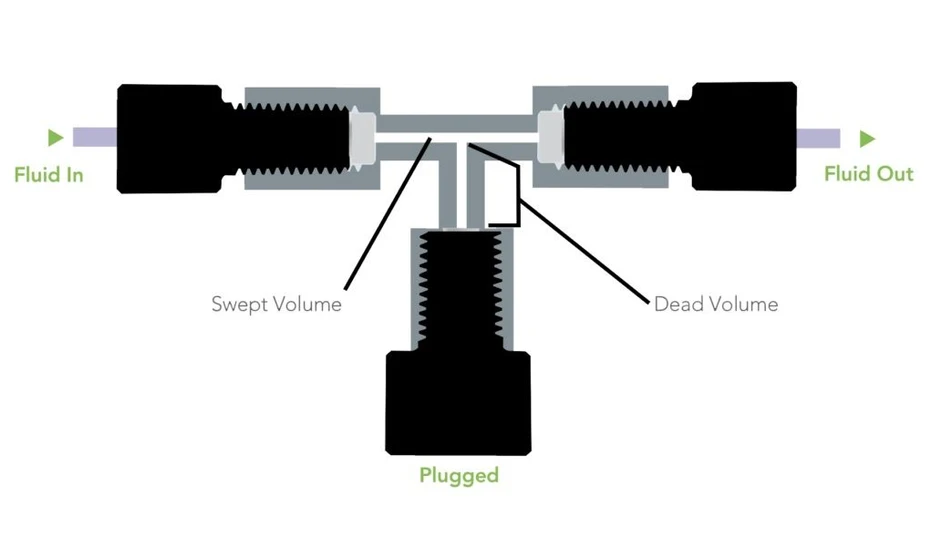
The dead volume is that portion of the void volume that is out of the flow path.

Swept Volume is that portion of the void volume in a connection directly in the fluid pathway.

Void Volume is simply another way of describe the total internal volume. It is defined as any space within connection into which fluid can flow.

So a simple equation applies: Void Volume = Dead Volume + Swept Volume

And why are we so interested in dead volume? Especially in capillary connections, it can cause some very undesirable chromatographic effects, including:

  • Analysis Delay
  • Broadened Peaks
  • Poor Resolution
  • Sample Carry-Over
  • Split Peaks
  • Gas Collection 

Therefore, in addition to keeping the volume inside the connection to a minimum, all dead volume should be removed from the connection if possible. Finally, in capillary connections, the preferred relationship could be expressed as follows:

Void Volume = Swept Volume (and should be REALLY small!)

By matching the tube ID as closely as possible to the diameter of the thru-holes in your equipment, you will ensure that most of the void volume will be swept volume. This diameter adjustment also helps to reduce the amount of turbulence that the fluid experiences as it passes through the connection.


Watrex Praha
LinkedIn Logo
 

Related articles

Advantages and disadvantages of substitution of helium as carrier gas in gas chromatography by hydrogen. Part III. - Sample introduction and detectors.
Scientific article | Academy

Advantages and disadvantages of substitution of helium as carrier gas in gas chromatography by hydrogen. Part III. - Sample introduction and detectors.

This paper addresses some specifics concerning the use of hydrogen as carrier gas in different techniques of sample introduction on chromatographic column.
Single-Ended HPLC Column by SIELC
Article | Product

Single-Ended HPLC Column by SIELC

SIELC introduces a single-ended HPLC column that eliminates fittings, dead volume, and leaks. Discover a new connection standard that simplifies installation, improves reliability, and streamlines LC workflows.
Let´s Connect a whole (U)HPLC system without tools and trouble
Article | Product

Let´s Connect a whole (U)HPLC system without tools and trouble

Discover how modern UHPLC capillary and fitting systems simplify installation, reduce dead volume, improve reliability, and save valuable laboratory time.
 Why Capillary LC Is the Future of LC-MS Sensitivity
Article | Interview

Why Capillary LC Is the Future of LC-MS Sensitivity

Samuel Foster discusses capillary LC, from dramatic solvent savings and enhanced ESI-MS sensitivity to extra-column effects, method translation, radiopharmaceuticals, and the future of miniaturized HPLC.
 

Related articles

Advantages and disadvantages of substitution of helium as carrier gas in gas chromatography by hydrogen. Part III. - Sample introduction and detectors.
Scientific article | Academy

Advantages and disadvantages of substitution of helium as carrier gas in gas chromatography by hydrogen. Part III. - Sample introduction and detectors.

This paper addresses some specifics concerning the use of hydrogen as carrier gas in different techniques of sample introduction on chromatographic column.
Single-Ended HPLC Column by SIELC
Article | Product

Single-Ended HPLC Column by SIELC

SIELC introduces a single-ended HPLC column that eliminates fittings, dead volume, and leaks. Discover a new connection standard that simplifies installation, improves reliability, and streamlines LC workflows.
Let´s Connect a whole (U)HPLC system without tools and trouble
Article | Product

Let´s Connect a whole (U)HPLC system without tools and trouble

Discover how modern UHPLC capillary and fitting systems simplify installation, reduce dead volume, improve reliability, and save valuable laboratory time.
 Why Capillary LC Is the Future of LC-MS Sensitivity
Article | Interview

Why Capillary LC Is the Future of LC-MS Sensitivity

Samuel Foster discusses capillary LC, from dramatic solvent savings and enhanced ESI-MS sensitivity to extra-column effects, method translation, radiopharmaceuticals, and the future of miniaturized HPLC.
 

Related articles

Advantages and disadvantages of substitution of helium as carrier gas in gas chromatography by hydrogen. Part III. - Sample introduction and detectors.
Scientific article | Academy

Advantages and disadvantages of substitution of helium as carrier gas in gas chromatography by hydrogen. Part III. - Sample introduction and detectors.

This paper addresses some specifics concerning the use of hydrogen as carrier gas in different techniques of sample introduction on chromatographic column.
Single-Ended HPLC Column by SIELC
Article | Product

Single-Ended HPLC Column by SIELC

SIELC introduces a single-ended HPLC column that eliminates fittings, dead volume, and leaks. Discover a new connection standard that simplifies installation, improves reliability, and streamlines LC workflows.
Let´s Connect a whole (U)HPLC system without tools and trouble
Article | Product

Let´s Connect a whole (U)HPLC system without tools and trouble

Discover how modern UHPLC capillary and fitting systems simplify installation, reduce dead volume, improve reliability, and save valuable laboratory time.
 Why Capillary LC Is the Future of LC-MS Sensitivity
Article | Interview

Why Capillary LC Is the Future of LC-MS Sensitivity

Samuel Foster discusses capillary LC, from dramatic solvent savings and enhanced ESI-MS sensitivity to extra-column effects, method translation, radiopharmaceuticals, and the future of miniaturized HPLC.
 

Related articles

Advantages and disadvantages of substitution of helium as carrier gas in gas chromatography by hydrogen. Part III. - Sample introduction and detectors.
Scientific article | Academy

Advantages and disadvantages of substitution of helium as carrier gas in gas chromatography by hydrogen. Part III. - Sample introduction and detectors.

This paper addresses some specifics concerning the use of hydrogen as carrier gas in different techniques of sample introduction on chromatographic column.
Single-Ended HPLC Column by SIELC
Article | Product

Single-Ended HPLC Column by SIELC

SIELC introduces a single-ended HPLC column that eliminates fittings, dead volume, and leaks. Discover a new connection standard that simplifies installation, improves reliability, and streamlines LC workflows.
Let´s Connect a whole (U)HPLC system without tools and trouble
Article | Product

Let´s Connect a whole (U)HPLC system without tools and trouble

Discover how modern UHPLC capillary and fitting systems simplify installation, reduce dead volume, improve reliability, and save valuable laboratory time.
 Why Capillary LC Is the Future of LC-MS Sensitivity
Article | Interview

Why Capillary LC Is the Future of LC-MS Sensitivity

Samuel Foster discusses capillary LC, from dramatic solvent savings and enhanced ESI-MS sensitivity to extra-column effects, method translation, radiopharmaceuticals, and the future of miniaturized HPLC.