HR-MS/MS EAD and CID fragmentation leads to selective, sensitive and reliable quantitation of anabolic steroids in urine
Th, 19.12.2024 | Original article from: Bioanalytic
HRMS offers a powerful tool to detect and identify drugs using mass defect data on precursor and quantifier ion with parallel spectral library matching followed by quantitative analysis at low levels.
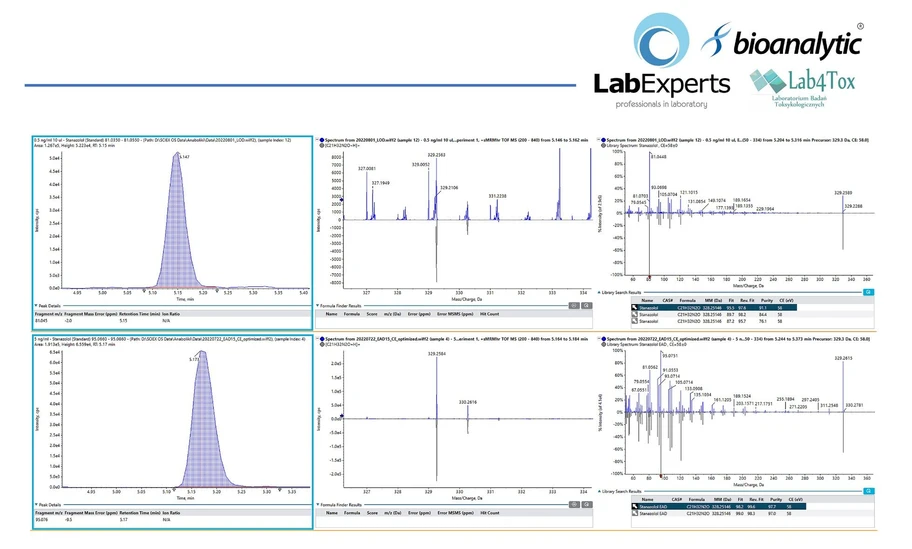
<ul><li><strong>Photo:</strong> Bioanalytic: Figure 3. Example data obtained using CID (up) nad EAD (down) fragmentation mode.</li></ul>
  • Photo: Bioanalytic: Figure 3. Example data obtained using CID (up) nad EAD (down) fragmentation mode.

Adrian Soboń (1,2); Julia Mironenka (1); Anna Lenartowicz (1); Rafał Szewczyk (1,2); Katarzyna Krupczyńska-Stopa (1,2); Maciej Stopa (1,2); Andrzej Kwaśnica (3)

1 – LabExperts sp. z o. o., Gdańsk, Poland; 2 – Bioanalytic sp. z o. o., Gdańsk, Poland; 3 – Lab4Tox sp. z o. o., Wrocław, Poland

Introduction

Anabolic androgenic steroids (AAS) are a group of natural and synthetic compounds that are chemically similar to and mimic the actions of endogenous testosterone. They stimulate androgen receptors, contributing to an increase in muscle mass and strength, and on the other hand reduction of body fat. Although the use of AAS in sports is banned, they are still the most abused class of drugs in sports. High-resolution mass spectrometry (HRMS) offers analytical laboratories a powerful tool to detect drugs and efficiently and confidently identify them using mass defect data on precursor and quantifier ion with parallel spectral library matching followed by quantitative analysis at low levels.

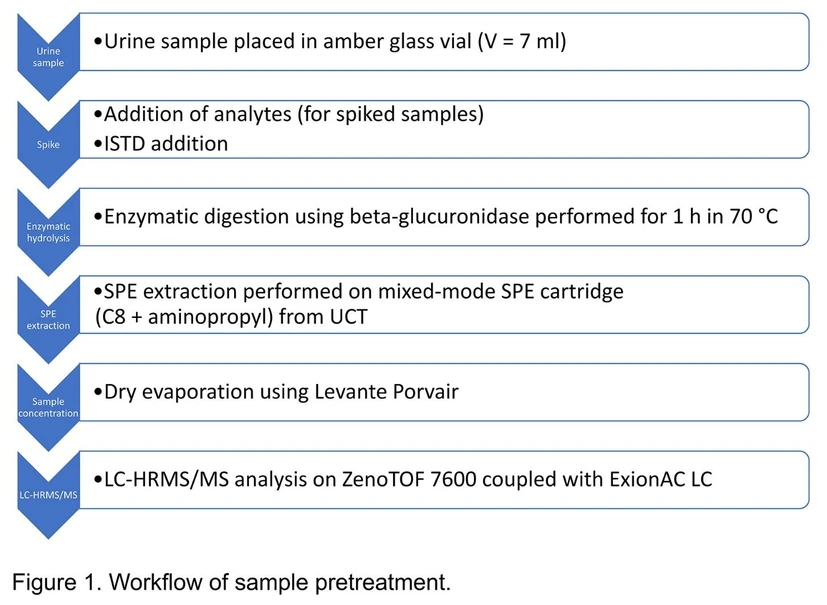
Bioanalytic: Figure 1. Workflow of sample pretreatment.Bioanalytic: Figure 1. Workflow of sample pretreatment.

Methods

Sample preparation starts with enzymatic hydrolysis of potential anabolic conjugates, followed by the clean-up procedure using a mix-mode SPE cartridge (C8 + aminopropyl). AAS were analyzed using ZenoTOF 7600 system with the time scheduled Zeno MRMhr for optimal sensitivity using both collision-induced dissociation (CID) and electron-activated dissociation (EAD).

Chromatographic separation was done on a Kinetex 2.6 µm XB-C18 (100 A; 100 x 2.1 mm) column using an ExionLC AC system (Sciex). Mobile phase solvents were water (A) and mix of methanol and acetonitrile (1:1 v/v) (B). Separation was performed at a flow rate of 500 µl/min with a column temperature of 40 °C. Data processing was made using SCIEX OS v.3.1 software.
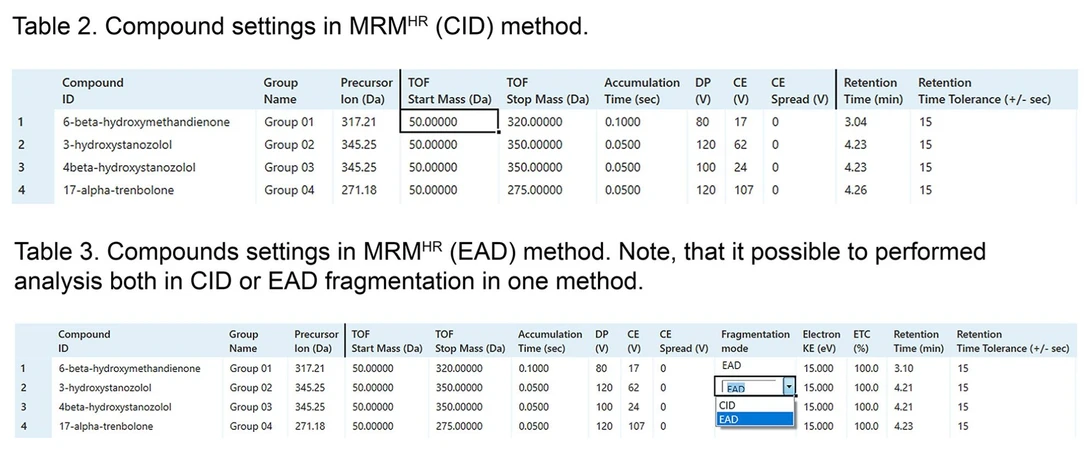
Bioanalytic: Table 2. Compounf settings in MRM HR (CID) method. Table 3. Compounds settings MRM HR (EAD) method. Note, that it possible performed both in CID or EAD fragmentation in one method.Bioanalytic: Table 2. Compounf settings in MRM HR (CID) method. Table 3. Compounds settings MRM HR (EAD) method. Note, that it possible performed both in CID or EAD fragmentation in one method.

Preliminary Data

The gold standard in the LC-MS/MS quantitation is the scanning of two MRM pairs on low resolution (LR) triple quad instrument – quantifier and qualifier ion. Unfortunately, matrix effects may lead to insufficient confirmation of compound presence, especially at low levels where MRM ratio and matrix interferences can lead to result misinterpretation. To overcome the specificity problems in the LR data, HR system was used to establish sensitive, selective, qualitative and quantitative method to determine 28 AAS in urine matrix.

Both collision-induced dissociation (CID) and electron-activated dissociation (EAD) fragmentation methods were used to select specific fragment ions for quantitation and MS/MS libraries for analytes. The matrix-matched calibration curves was prepared in the range of 0.01 – 100 ng/ml. The linearity range (r ≥ 0.995) of the curves were analyte dependent. Lower limits of quantification can be achieved for some compounds.

EAD is an alternative fragmentation mode that produces unique fragmentation ions, which can be used as diagnostic ions for compound differentiation. The creation of our own library was important because in the developed method MS/MS spectrum is collected for the optimized collision energy (CE), while the spectra deposited in commercial databases are generated at a constant CE value and contain only a few of the tested substances. Moreover, there are no commercial databases for EAD fragmentation data.

The created LC-MS/MS method is characterized not only by high sensitivity, but by using a HR-MS/MS, it enables determination of additional factors confirming the presence of the compound including mass defect for precursor and quantifier ion, isotope distribution and finally library matching.

In addition, the presence of Zeno ion trap gives better quality and sensitivity of the fragmentation spectrum. The developed LC-HR-MS/MS method is characterized by a much better specificity compared to the analyzes performed on any LR device.
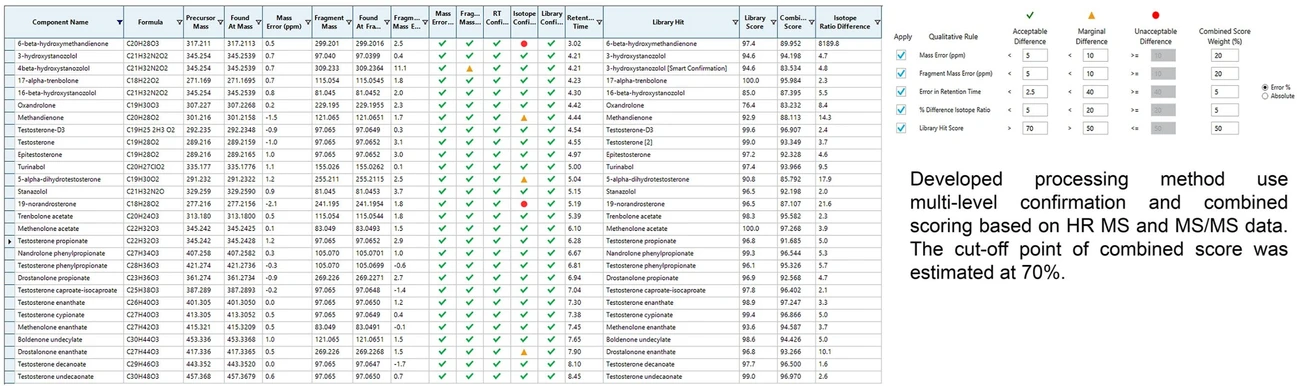
Bioanalytic: Table 4. Example of multi-level confirmation and scoring by the anabolic AAS method in urine using ZENO TOF 7600 LC-MS/MS system.Bioanalytic: Table 4. Example of multi-level confirmation and scoring by the anabolic AAS method in urine using ZENO TOF 7600 LC-MS/MS system.

Novel aspect

Sensitive and selective LC-HR-MS/MS method using CID and EAD fragmentation modes for anabolic steroids quantitation in human urine with confidence.


Bioanalytic
LinkedIn Logo
 

Related articles

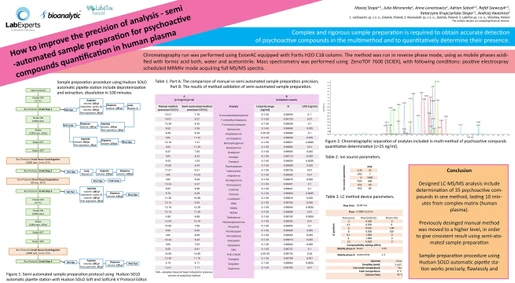
How to improve the precision of analysis – semi-automated sample preparation for psychoactive compounds quantification in human plasma
Article | Poster

How to improve the precision of analysis – semi-automated sample preparation for psychoactive compounds quantification in human plasma

This work shows the effective translation from manual method to semi-automated procedure of determination of 34 psychoactive compounds from human plasma using LC-MS/MS method.
Sensitive quantitative LC-MS/MS method of steroid hormones determination in adipose tissue as a helpful tool in obesity research
Article | Poster

Sensitive quantitative LC-MS/MS method of steroid hormones determination in adipose tissue as a helpful tool in obesity research

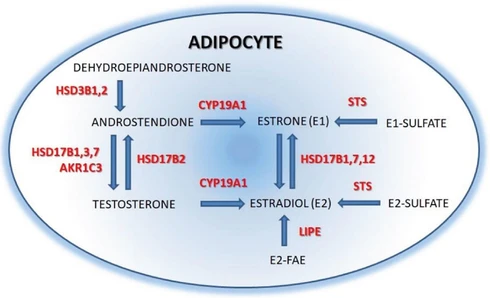
We present LC-MS/MS method for a quantitative determination of estradiol, estrone, androstenedione and testosterone in human adipose tissue.
How sure you can be of the results of quantification of psychoactive compounds in blood?
Article | Poster

How sure you can be of the results of quantification of psychoactive compounds in blood?

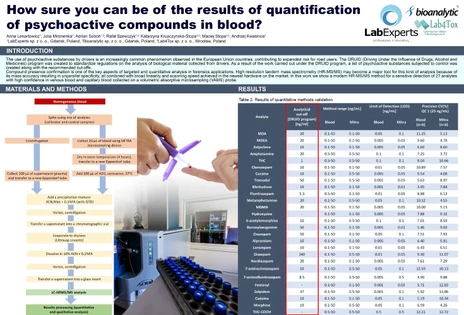
In this work we show a HR-MS/MS method for a sensitive detection of 27 psychoactive compounds with high confidence in venous blood and blood collected on a volumetric absorptive microsampling (VAMS) probe.
General Screening and Multiple Dissociation Methods for Complementary LC–MS Analysis of Pesticides in Beverages: Potential and Pitfalls
Scientific article | Science and research

General Screening and Multiple Dissociation Methods for Complementary LC–MS Analysis of Pesticides in Beverages: Potential and Pitfalls

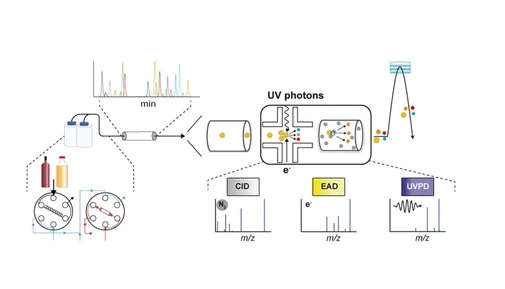
A ZenoTOF 7600 modified for CID, EAD, and UVPD allowed LC–MS screening of pesticides in juices and wines. About 30 were detected at pg–ng/mL levels, confirmed by multiple dissociation methods.
 

Related articles

How to improve the precision of analysis – semi-automated sample preparation for psychoactive compounds quantification in human plasma
Article | Poster

How to improve the precision of analysis – semi-automated sample preparation for psychoactive compounds quantification in human plasma

This work shows the effective translation from manual method to semi-automated procedure of determination of 34 psychoactive compounds from human plasma using LC-MS/MS method.
Sensitive quantitative LC-MS/MS method of steroid hormones determination in adipose tissue as a helpful tool in obesity research
Article | Poster

Sensitive quantitative LC-MS/MS method of steroid hormones determination in adipose tissue as a helpful tool in obesity research

We present LC-MS/MS method for a quantitative determination of estradiol, estrone, androstenedione and testosterone in human adipose tissue.
How sure you can be of the results of quantification of psychoactive compounds in blood?
Article | Poster

How sure you can be of the results of quantification of psychoactive compounds in blood?

In this work we show a HR-MS/MS method for a sensitive detection of 27 psychoactive compounds with high confidence in venous blood and blood collected on a volumetric absorptive microsampling (VAMS) probe.
General Screening and Multiple Dissociation Methods for Complementary LC–MS Analysis of Pesticides in Beverages: Potential and Pitfalls
Scientific article | Science and research

General Screening and Multiple Dissociation Methods for Complementary LC–MS Analysis of Pesticides in Beverages: Potential and Pitfalls

A ZenoTOF 7600 modified for CID, EAD, and UVPD allowed LC–MS screening of pesticides in juices and wines. About 30 were detected at pg–ng/mL levels, confirmed by multiple dissociation methods.
 

Related articles

How to improve the precision of analysis – semi-automated sample preparation for psychoactive compounds quantification in human plasma
Article | Poster

How to improve the precision of analysis – semi-automated sample preparation for psychoactive compounds quantification in human plasma

This work shows the effective translation from manual method to semi-automated procedure of determination of 34 psychoactive compounds from human plasma using LC-MS/MS method.
Sensitive quantitative LC-MS/MS method of steroid hormones determination in adipose tissue as a helpful tool in obesity research
Article | Poster

Sensitive quantitative LC-MS/MS method of steroid hormones determination in adipose tissue as a helpful tool in obesity research

We present LC-MS/MS method for a quantitative determination of estradiol, estrone, androstenedione and testosterone in human adipose tissue.
How sure you can be of the results of quantification of psychoactive compounds in blood?
Article | Poster

How sure you can be of the results of quantification of psychoactive compounds in blood?

In this work we show a HR-MS/MS method for a sensitive detection of 27 psychoactive compounds with high confidence in venous blood and blood collected on a volumetric absorptive microsampling (VAMS) probe.
General Screening and Multiple Dissociation Methods for Complementary LC–MS Analysis of Pesticides in Beverages: Potential and Pitfalls
Scientific article | Science and research

General Screening and Multiple Dissociation Methods for Complementary LC–MS Analysis of Pesticides in Beverages: Potential and Pitfalls

A ZenoTOF 7600 modified for CID, EAD, and UVPD allowed LC–MS screening of pesticides in juices and wines. About 30 were detected at pg–ng/mL levels, confirmed by multiple dissociation methods.
 

Related articles

How to improve the precision of analysis – semi-automated sample preparation for psychoactive compounds quantification in human plasma
Article | Poster

How to improve the precision of analysis – semi-automated sample preparation for psychoactive compounds quantification in human plasma

This work shows the effective translation from manual method to semi-automated procedure of determination of 34 psychoactive compounds from human plasma using LC-MS/MS method.
Sensitive quantitative LC-MS/MS method of steroid hormones determination in adipose tissue as a helpful tool in obesity research
Article | Poster

Sensitive quantitative LC-MS/MS method of steroid hormones determination in adipose tissue as a helpful tool in obesity research

We present LC-MS/MS method for a quantitative determination of estradiol, estrone, androstenedione and testosterone in human adipose tissue.
How sure you can be of the results of quantification of psychoactive compounds in blood?
Article | Poster

How sure you can be of the results of quantification of psychoactive compounds in blood?

In this work we show a HR-MS/MS method for a sensitive detection of 27 psychoactive compounds with high confidence in venous blood and blood collected on a volumetric absorptive microsampling (VAMS) probe.
General Screening and Multiple Dissociation Methods for Complementary LC–MS Analysis of Pesticides in Beverages: Potential and Pitfalls
Scientific article | Science and research

General Screening and Multiple Dissociation Methods for Complementary LC–MS Analysis of Pesticides in Beverages: Potential and Pitfalls

A ZenoTOF 7600 modified for CID, EAD, and UVPD allowed LC–MS screening of pesticides in juices and wines. About 30 were detected at pg–ng/mL levels, confirmed by multiple dissociation methods.