Studying the mechanosensitivity of neurons at nano-scale

Tu, 13.8.2024 | Original article from: ETH Zürich / Carolin Arndt Foppa
In a new study, researchers reveal how neurons sense the magnitude and temporal features of physical forces.
  • Photo: ETH Zürich: Studying the mechanosensitivity of neurons at nano-scale
  • Video: TheHITSters: HITS Colloquium: Daniel Müller on mechanobiology

Right from the early developmental stages to fully grown adults, brain cells continuously rely on mechanical cues to migrate to the correct locations in the body, form connections with other neurons or other cell types and communicate with them in a unique language of electrical impulses. In a new study, researchers from the Biophysics group of Daniel Müller and the Bio Engineering Lab of Andreas Hierlemann reveal how neurons sense the magnitude and temporal features of physical forces.
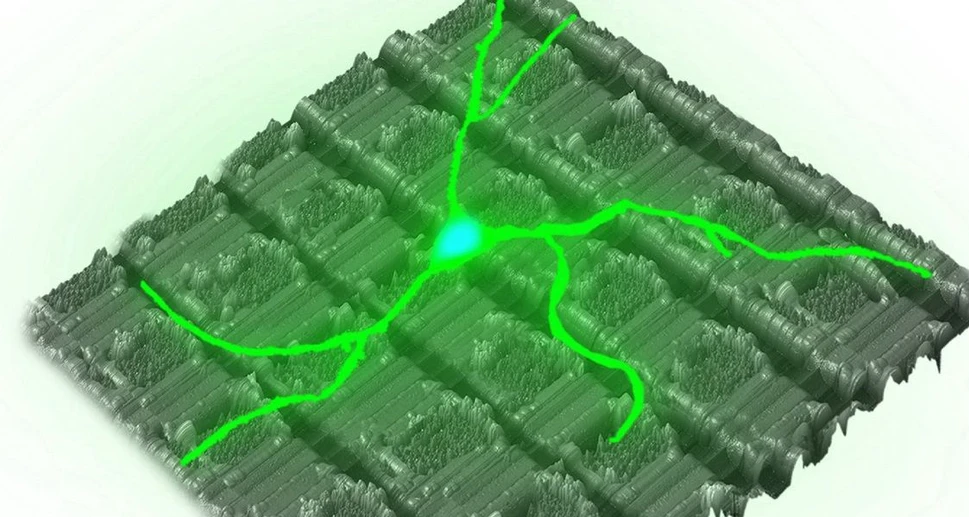
ETH Zurich: Studying the mechanosensitivity of neurons at nano-scale.ETH Zurich: Studying the mechanosensitivity of neurons at nano-scale.

Studying the brain, a mechanosensitive organ, requires precise tools that can see neuronal cells in action, catch the forces at play, and listen in on their electrical conversations, in other words: tools that mechanically stimulate and simultaneously record the electrophysiological response of neurons within neuronal networks. By combining atomic force microscopy (AFM), fluorescence microscopy and high-density micro-electrode arrays, the group of researchers led by Krishna Kasuba measures and characterises the mechanical properties of neurons at nano-scales. One key finding: Neurons differentiate between various mechanical stimuli and functionally respond in a different manner. This line-up of tools opens the door to explore new ways of mechanical characterisation, stimulation and control of complex electrogenic biological systems in organoids and tissues.

Find research article in Nature Nanotechnology:

Kasuba, K C, A P Buccino, J Bartram, B M Gaub, F J Fauser, S Ronchi, S S Kumar, S Geissler, M M Nava, A Hierlemann and D J Müller (2024) Mechanical stimulation and electrophysiological monitoring at subcellular resolution reveals differential mechanosensation of neurons within networks. Nature Nanotechnology, https://doi.org/10.1038/s41565-024-01609-1

Learn about the Biophysics lab led by Daniel Müller, the Bio Engineering Lab of Andreas Hierlemann.


ETH Zürich
LinkedIn Logo
 

Related articles

Water quality monitor, locust-inspired electronic nose under development
Article | Video

Water quality monitor, locust-inspired electronic nose under development

Teams led by Barani Raman, Dan Giammar awarded $650,000 National Science Foundation Convergence Accelerator grants.
WashU researchers shine light on amyloid architecture
Article | Scientific article

WashU researchers shine light on amyloid architecture

Lew lab’s innovative microscopy charts amyloid beta’s underlying structure, could yield insight into neurodegenerative disease.
100 years since the birth of the father of Czechoslovak electron microscopy
Article | Scientists

100 years since the birth of the father of Czechoslovak electron microscopy

Brno excels in electron microscopy, drawing on Armin Delong's legacy. Brno University of Technology, where he studied and earned an honorary doctorate in 2014, considers it a strategic focus.
ABCA7 deficiency exacerbates glutamate excitotoxicity in Alzheimer’s disease mice – A new pharmacological target for Glu-related neurotoxicity
Scientific article | Science and research

ABCA7 deficiency exacerbates glutamate excitotoxicity in Alzheimer’s disease mice – A new pharmacological target for Glu-related neurotoxicity

This study shows that ABCA7 deficiency amplifies glutamate excitotoxicity in Alzheimer's disease, highlighting a promising drug target.
 

Related articles

Water quality monitor, locust-inspired electronic nose under development
Article | Video

Water quality monitor, locust-inspired electronic nose under development

Teams led by Barani Raman, Dan Giammar awarded $650,000 National Science Foundation Convergence Accelerator grants.
WashU researchers shine light on amyloid architecture
Article | Scientific article

WashU researchers shine light on amyloid architecture

Lew lab’s innovative microscopy charts amyloid beta’s underlying structure, could yield insight into neurodegenerative disease.
100 years since the birth of the father of Czechoslovak electron microscopy
Article | Scientists

100 years since the birth of the father of Czechoslovak electron microscopy

Brno excels in electron microscopy, drawing on Armin Delong's legacy. Brno University of Technology, where he studied and earned an honorary doctorate in 2014, considers it a strategic focus.
ABCA7 deficiency exacerbates glutamate excitotoxicity in Alzheimer’s disease mice – A new pharmacological target for Glu-related neurotoxicity
Scientific article | Science and research

ABCA7 deficiency exacerbates glutamate excitotoxicity in Alzheimer’s disease mice – A new pharmacological target for Glu-related neurotoxicity

This study shows that ABCA7 deficiency amplifies glutamate excitotoxicity in Alzheimer's disease, highlighting a promising drug target.
 

Related articles

Water quality monitor, locust-inspired electronic nose under development
Article | Video

Water quality monitor, locust-inspired electronic nose under development

Teams led by Barani Raman, Dan Giammar awarded $650,000 National Science Foundation Convergence Accelerator grants.
WashU researchers shine light on amyloid architecture
Article | Scientific article

WashU researchers shine light on amyloid architecture

Lew lab’s innovative microscopy charts amyloid beta’s underlying structure, could yield insight into neurodegenerative disease.
100 years since the birth of the father of Czechoslovak electron microscopy
Article | Scientists

100 years since the birth of the father of Czechoslovak electron microscopy

Brno excels in electron microscopy, drawing on Armin Delong's legacy. Brno University of Technology, where he studied and earned an honorary doctorate in 2014, considers it a strategic focus.
ABCA7 deficiency exacerbates glutamate excitotoxicity in Alzheimer’s disease mice – A new pharmacological target for Glu-related neurotoxicity
Scientific article | Science and research

ABCA7 deficiency exacerbates glutamate excitotoxicity in Alzheimer’s disease mice – A new pharmacological target for Glu-related neurotoxicity

This study shows that ABCA7 deficiency amplifies glutamate excitotoxicity in Alzheimer's disease, highlighting a promising drug target.
 

Related articles

Water quality monitor, locust-inspired electronic nose under development
Article | Video

Water quality monitor, locust-inspired electronic nose under development

Teams led by Barani Raman, Dan Giammar awarded $650,000 National Science Foundation Convergence Accelerator grants.
WashU researchers shine light on amyloid architecture
Article | Scientific article

WashU researchers shine light on amyloid architecture

Lew lab’s innovative microscopy charts amyloid beta’s underlying structure, could yield insight into neurodegenerative disease.
100 years since the birth of the father of Czechoslovak electron microscopy
Article | Scientists

100 years since the birth of the father of Czechoslovak electron microscopy

Brno excels in electron microscopy, drawing on Armin Delong's legacy. Brno University of Technology, where he studied and earned an honorary doctorate in 2014, considers it a strategic focus.
ABCA7 deficiency exacerbates glutamate excitotoxicity in Alzheimer’s disease mice – A new pharmacological target for Glu-related neurotoxicity
Scientific article | Science and research

ABCA7 deficiency exacerbates glutamate excitotoxicity in Alzheimer’s disease mice – A new pharmacological target for Glu-related neurotoxicity

This study shows that ABCA7 deficiency amplifies glutamate excitotoxicity in Alzheimer's disease, highlighting a promising drug target.