Novel fluorescent probe for real-time imaging of nascent DNA in live cells
Tu, 30.4.2024 | Original article from: IOCB Prague
Novel 2′-deoxycytidine triphosphate (dCTP) nucleotide modified with a thiazole orange fluorophore can be incorporated into DNA strand by DNA polymerases in vitro as well as in live cells.
<ul>
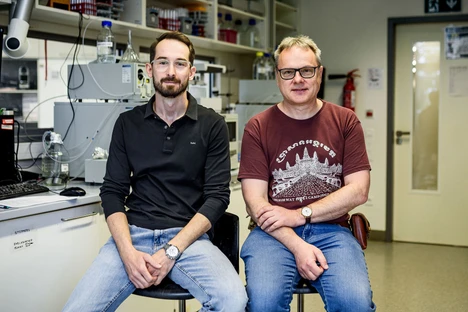
<li><strong>Photo:</strong> IOCB Prague: Novel fluorescent probe for real-time imaging of nascent DNA in live cells</li>
</ul>
  • Photo: IOCB Prague: Novel fluorescent probe for real-time imaging of nascent DNA in live cells

The investigation of the organization, function, and dynamics of genomic DNA in chromatin is a challenging topic that can be addressed by fluorescence microscopy. Conventional DNA labeling methods employ metabolically active non-natural nucleoside analogs with subsequent secondary labeling with antibodies or fluorescent tags. But these methods do not allow for truly real-time monitoring of the nascent DNA in live cells due to the background signal of non-incorporated labeled nucleosides abundantly present in the intracellular space.

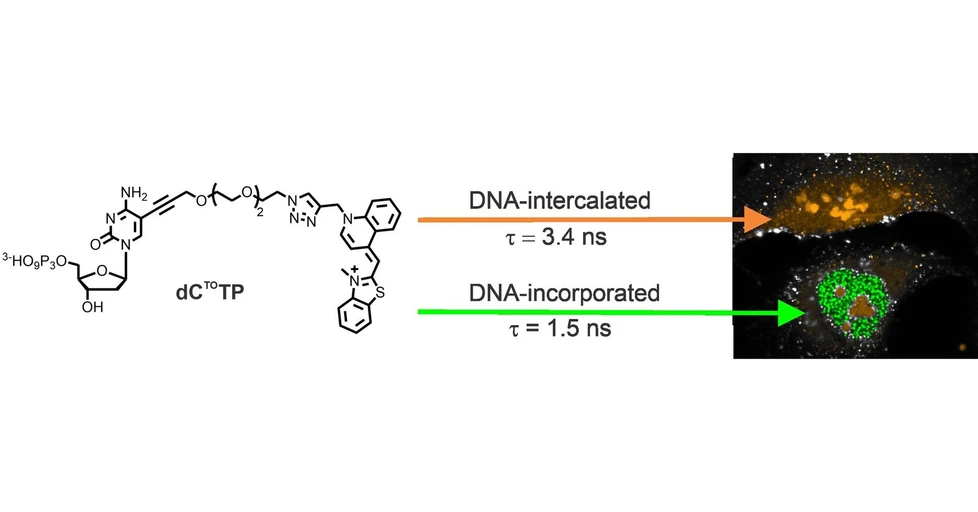
The researchers led by Tomáš Kraus from IOCB Prague and Michal Hocek from IOCB Prague and Charles University designed and synthesized a novel 2′-deoxycytidine triphosphate (dCTP) nucleotide modified with a thiazole orange fluorophore, which can be incorporated into DNA strand by DNA polymerases in vitro as well as in live cells. Upon incorporation of the modified nucleotide into DNA, the fluorescence of thiazole orange moiety exhibits a shorter lifetime that differs significantly from the intercalated non-incorporated form.

Due to this measurable difference, DNA synthesis in live cells can be monitored in real-time using fluorescence lifetime imaging microscopy. This has allowed the scientists to distinguish and monitor cells which are actively synthesizing DNA from the very first moments after the probe treatment.
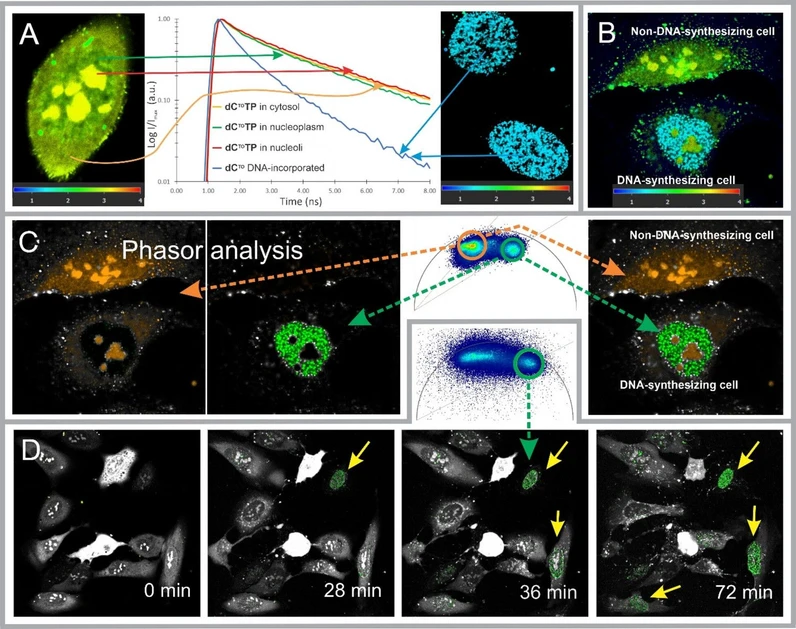
IOCB Prague: Real-time imaging of in cellulo incorporation of dCOTP into genomic DNA.IOCB Prague: Real-time imaging of in cellulo incorporation of dCOTP into genomic DNA.

This novel approach, published in Angewandte Chemie International Edition journal, can be exploited in studies of genomic DNA organization, dynamics, and function.

Resources

Read the paper: Kuba, M.; Khoroshyy, P.; Lepšík, M.; Kužmová, E.; Kodr, D.; Kraus, T.; Hocek, M. Real-time Imaging of Nascent DNA in Live Cells by Monitoring the Fluorescence Lifetime of DNA-Incorporated Thiazole Orange-Modified Nucleotides. Angew. Chem. Int. Ed. 2023, e202307548. https://doi.org/10.1002/anie.202307548


Institute of Organic Chemistry and Biochemistry of the Czech Academy of Sciences
LinkedIn Logo
 

Related articles

Researchers at IOCB Prague develop a new method for enzymatic synthesis of potential RNA therapeutics
Article | Science and research

Researchers at IOCB Prague develop a new method for enzymatic synthesis of potential RNA therapeutics

A team of researchers at IOCB Prague led by Prof. Michal Hock has developed a novel method for preparing ribonucleic acid (RNA) containing modified bases.
Scientists from IOCB Prague are pushing the limits of DNA
Article | Video

Scientists from IOCB Prague are pushing the limits of DNA

Even heavily modified double helices of DNA are stable enough to be used for special applications.
Research from IOCB Prague reveals a previously unknown mechanism of genetic transcription
Article | Science and research

Research from IOCB Prague reveals a previously unknown mechanism of genetic transcription

Scientists at IOCB Prague reveal a previously unknown mechanism that initiates gene transcription. Using cryo-EM, they uncover how alarmone molecules enable RNA synthesis under stress.
New technology streamlines the development of aptamers, synthetic alternatives to antibodies
Article | Science and research

New technology streamlines the development of aptamers, synthetic alternatives to antibodies

Scientists at IOCB Prague developed a breakthrough technology that accelerates aptamer discovery, opening new opportunities for diagnostics, therapeutics, and wearable biosensors.
 

Related articles

Researchers at IOCB Prague develop a new method for enzymatic synthesis of potential RNA therapeutics
Article | Science and research

Researchers at IOCB Prague develop a new method for enzymatic synthesis of potential RNA therapeutics

A team of researchers at IOCB Prague led by Prof. Michal Hock has developed a novel method for preparing ribonucleic acid (RNA) containing modified bases.
Scientists from IOCB Prague are pushing the limits of DNA
Article | Video

Scientists from IOCB Prague are pushing the limits of DNA

Even heavily modified double helices of DNA are stable enough to be used for special applications.
Research from IOCB Prague reveals a previously unknown mechanism of genetic transcription
Article | Science and research

Research from IOCB Prague reveals a previously unknown mechanism of genetic transcription

Scientists at IOCB Prague reveal a previously unknown mechanism that initiates gene transcription. Using cryo-EM, they uncover how alarmone molecules enable RNA synthesis under stress.
New technology streamlines the development of aptamers, synthetic alternatives to antibodies
Article | Science and research

New technology streamlines the development of aptamers, synthetic alternatives to antibodies

Scientists at IOCB Prague developed a breakthrough technology that accelerates aptamer discovery, opening new opportunities for diagnostics, therapeutics, and wearable biosensors.
 

Related articles

Researchers at IOCB Prague develop a new method for enzymatic synthesis of potential RNA therapeutics
Article | Science and research

Researchers at IOCB Prague develop a new method for enzymatic synthesis of potential RNA therapeutics

A team of researchers at IOCB Prague led by Prof. Michal Hock has developed a novel method for preparing ribonucleic acid (RNA) containing modified bases.
Scientists from IOCB Prague are pushing the limits of DNA
Article | Video

Scientists from IOCB Prague are pushing the limits of DNA

Even heavily modified double helices of DNA are stable enough to be used for special applications.
Research from IOCB Prague reveals a previously unknown mechanism of genetic transcription
Article | Science and research

Research from IOCB Prague reveals a previously unknown mechanism of genetic transcription

Scientists at IOCB Prague reveal a previously unknown mechanism that initiates gene transcription. Using cryo-EM, they uncover how alarmone molecules enable RNA synthesis under stress.
New technology streamlines the development of aptamers, synthetic alternatives to antibodies
Article | Science and research

New technology streamlines the development of aptamers, synthetic alternatives to antibodies

Scientists at IOCB Prague developed a breakthrough technology that accelerates aptamer discovery, opening new opportunities for diagnostics, therapeutics, and wearable biosensors.
 

Related articles

Researchers at IOCB Prague develop a new method for enzymatic synthesis of potential RNA therapeutics
Article | Science and research

Researchers at IOCB Prague develop a new method for enzymatic synthesis of potential RNA therapeutics

A team of researchers at IOCB Prague led by Prof. Michal Hock has developed a novel method for preparing ribonucleic acid (RNA) containing modified bases.
Scientists from IOCB Prague are pushing the limits of DNA
Article | Video

Scientists from IOCB Prague are pushing the limits of DNA

Even heavily modified double helices of DNA are stable enough to be used for special applications.
Research from IOCB Prague reveals a previously unknown mechanism of genetic transcription
Article | Science and research

Research from IOCB Prague reveals a previously unknown mechanism of genetic transcription

Scientists at IOCB Prague reveal a previously unknown mechanism that initiates gene transcription. Using cryo-EM, they uncover how alarmone molecules enable RNA synthesis under stress.
New technology streamlines the development of aptamers, synthetic alternatives to antibodies
Article | Science and research

New technology streamlines the development of aptamers, synthetic alternatives to antibodies

Scientists at IOCB Prague developed a breakthrough technology that accelerates aptamer discovery, opening new opportunities for diagnostics, therapeutics, and wearable biosensors.