
Zaměření
Type of News
Focus
Article | Academy
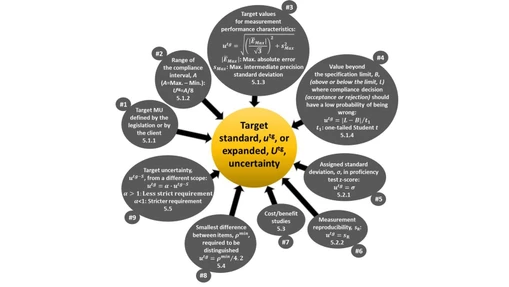
Setting Target Measurement Uncertainty
How small should measurement uncertainty be? Eurachem explains how target measurement uncertainty helps laboratories ensure results are fit for purpose and support reliable decisions.

Article | Academy
Treatment of an observed bias
How should laboratories handle a significant measurement bias? This Eurachem leaflet explains when correction is justified and how an uncorrected bias may affect measurement uncertainty.
Article | Academy
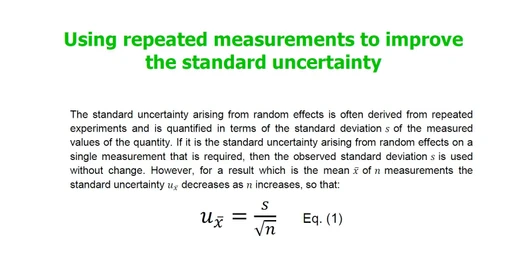
Using repeated measurements to improve the standard uncertainty
Learn when repeated measurements reduce standard uncertainty, when Equation (1) applies, and how to correctly evaluate uncertainty for grouped, correlated, and time-dependent analytical data.
Article | Academy
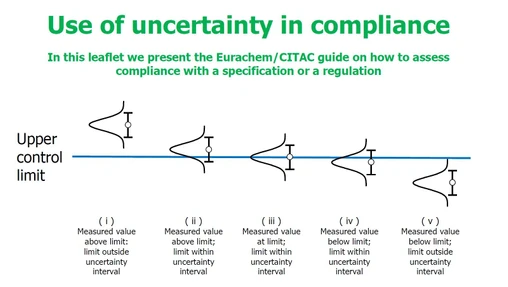
Use of uncertainty in compliance
In this leaflet we present the Eurachem/CITAC guide on how to assess compliance with a specification or a regulation.

Article | Academy
Metrological Traceability of Analytical Results
In this leaflet we explain the concept of metrological traceability
and illustrate how a laboratory can demonstrate the traceability of its results.

Article | Academy
Important information to our customers concerning the quality of measurements
Learn why measurement uncertainty is essential for interpreting analytical results, making reliable decisions, comparing laboratory data, and ensuring compliance with modern testing standards.
Article | Academy
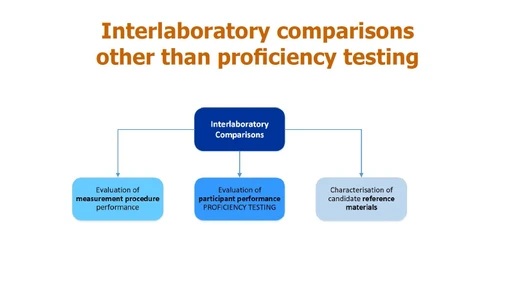
Interlaboratory comparisons other than proficiency testing
Learn how interlaboratory comparisons (ILCs) other than proficiency testing differ from PT schemes, their intended purposes, limitations, and how they support ISO/IEC 17025 compliance.
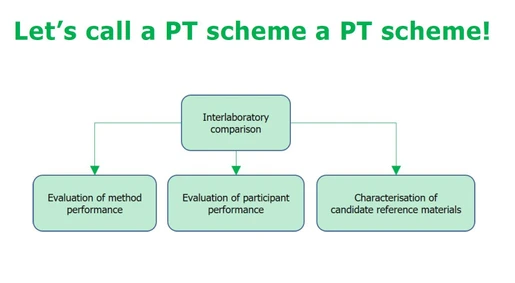
Article | Academy
Let’s call a PT scheme a PT scheme!
Interlaboratory comparisons, proficiency testing, ring tests, and round robins are often confused. Learn the correct terminology, key differences, and the importance of harmonized language in quality assurance.
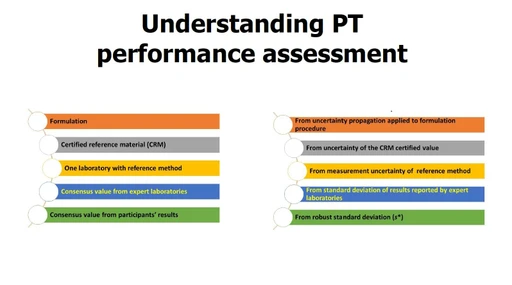
Article | Academy
Understanding PT performance assessment
Learn how proficiency testing providers assign reference values, estimate uncertainties, calculate performance scores, and interpret z, zeta, En, and percentage difference results.
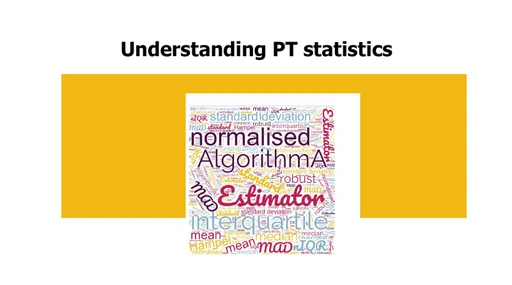
Article | Academy
Understanding PT statistics
Learn how proficiency testing providers calculate assigned values, uncertainty, and data dispersion, and how these statistics help laboratories interpret PT results correctly.