St, 25.11.2026 16:00 CET
Zjistěte, jak pomocí UHPLC-MS/MS stanovit 28 sloučenin PFAS ve slepičích vejcích a jak volba extrakčního postupu a vynechání čištění vzorku ovlivňují výsledky analýzy.Přejít na webinář

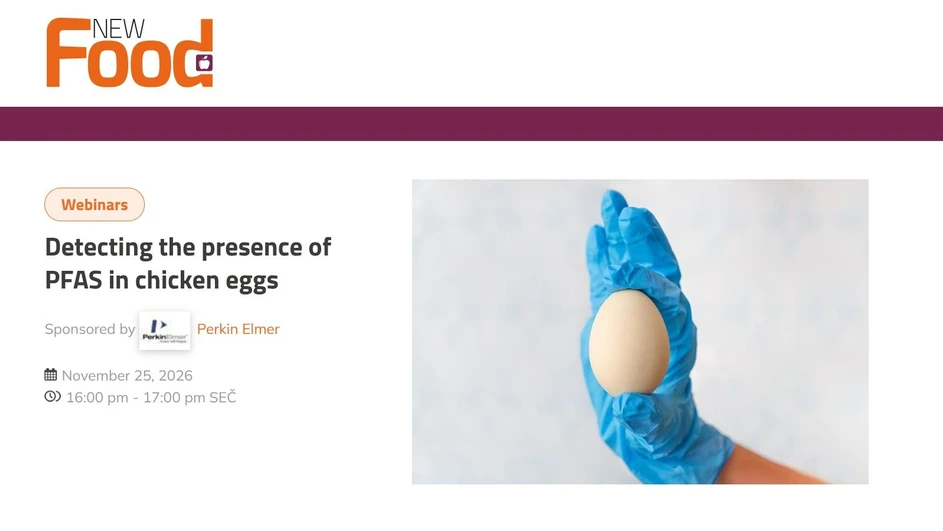
Free webinar: a University of Connecticut case study assessing PFAS contamination in a complex food matrix using UHPLC-MS/MS technology, and whether a faster extraction method holds up.
Long-chain PFAS compounds can remain in the body for years, and even small exposures accumulate, mainly through contaminated food, water and air. Researchers at the University of Connecticut’s Center for Environmental Sciences and Engineering looked at one specific food source: chicken eggs. Using a method built to test for 28 PFAS compounds with UHPLC-MS/MS, they compared two extraction approaches to see whether skipping a sample cleanup step would change the result.
This free webinar, sponsored by PerkinElmer, puts that question to the researchers who ran the study. Marisa Vatteroni and Dr Anthony Provatas of UConn’s CESE will walk through how the two extraction methods compared, what skipping cleanup did and did not change, and what a faster workflow means for how much PFAS testing a lab can realistically run.
By learning how to investigate and control the important factors in HPLC separations, attendees will be able to develop good, new methods for new products that are brought to market. As in any process that analyzes material for public consumption, improved analytical methods minimize unplanned downtime, increase lab efficiency and safe-guard the quality of those products. Less Downtime-More Sample Throughput.
Presenter: Dr Anthony Provatas
Dr Anthony Provatas is Director of the Organic Molecular Analysis Laboratory at UConn’s Center for Environmental Sciences and Engineering (CESE), where he provides guidance on complex analytical challenges and oversees the delivery of the Center’s scientific work. He also serves as a Research Professor in UConn Chemistry, mentoring undergraduate students and guiding independent research projects at CESE.
Presenter: Marisa Vatteroni
Marisa Vatteroni is a Research Associate with the Center for Environmental Sciences and Engineering at the University of Connecticut. She graduated from the University of Connecticut in 2023 with a Bachelor of Science in Chemistry and has worked in an industry or research lab for three years. She is experienced in both GC-MS/MS and UHPLC-MS/MS analysis and has worked on many projects researching PFAS contamination across various matrices.