Po, 26.10.2026 17:00 CET
Připojte se na webinář Specac o DRIFTS. Poznejte sledování rychlé kinetiky na povrchu katalyzátorů a tranzitních dějů při FTIR analýze.Přejít na webinář
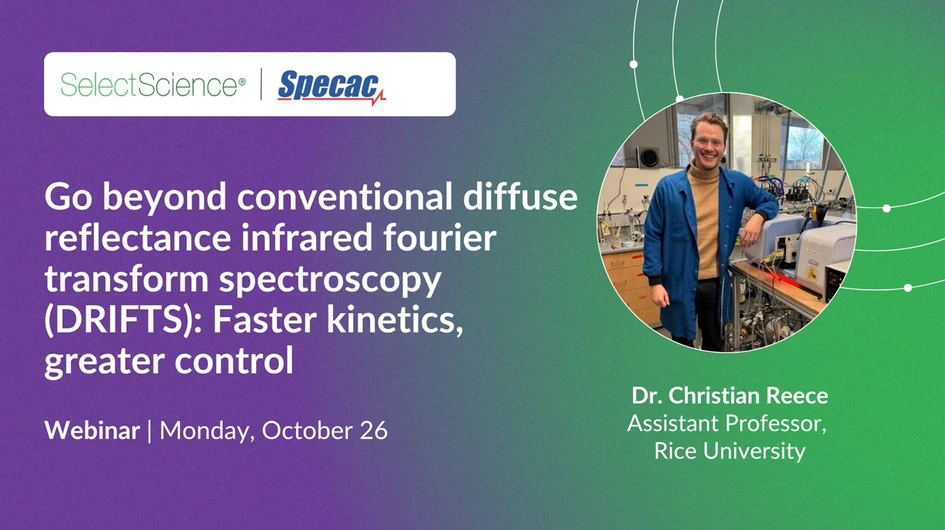
What happens on a catalyst surface during the fastest stages of a reaction? Conventional DRIFTS setups can struggle to capture transient changes under realistic operating conditions, limiting insight into catalytic mechanisms.
Join Dr. Christian Reece from Rice University to explore how operando DRIFTS can resolve faster surface kinetics, preserve sample integrity across repeated experiments, and support emerging applications in electrocatalysis. Drawing on studies of CO adsorption and desorption on palladium catalysts, Dr. Reece will provide practical guidance for obtaining more reliable and informative data from catalytic surface analysis.
Certificate of attendance
If you attend the live webinar, you will automatically receive a certificate of attendance, including a learning outcomes summary, for continuing education purposes.
If you view the on-demand webinar, you can request a certificate of attendance by emailing [email protected].
Registration is required to secure your place. If you register but can’t attend live, you will receive a link to the on‑demand recording once it becomes available.
This event is perfect for:
Presenter: Dr. Christian Reece (Assistant Professor, Rice University)
Dr. Christian Reece earned his PhD from Cardiff University, where he focused on using DFT and kinetic analysis to understand and design heterogeneous catalysts. He then joined Harvard University as a postdoctoral fellow with Professor Robert J. Madix, developing transient pulse techniques and kinetic modeling to rationalize catalytic behavior, before joining the Rowland Fellows program in July 2019 to design transient experiments predicting catalytic behavior. In July 2026, he brought his Reece Lab to the Department of Chemistry at Rice University, where his group combines kinetic modeling, spectroscopy and DFT – including Pulse-Probe DRIFTS built on Harrick reaction chambers.
Moderator: Todd Beanlands (Science Editor, SelectScience)
Leader of global spectroscopy application development and customer engagement efforts, supporting advanced research and industrial spectroscopy workflows.


