St, 18.11.2026 17:00 CET
Připojte se na webinář Waters a BioSpring o LC-MS mapování RNA. Poznejte strategie sekvenování a charakterizace sgRNA a mRNA.Přejít na webinář
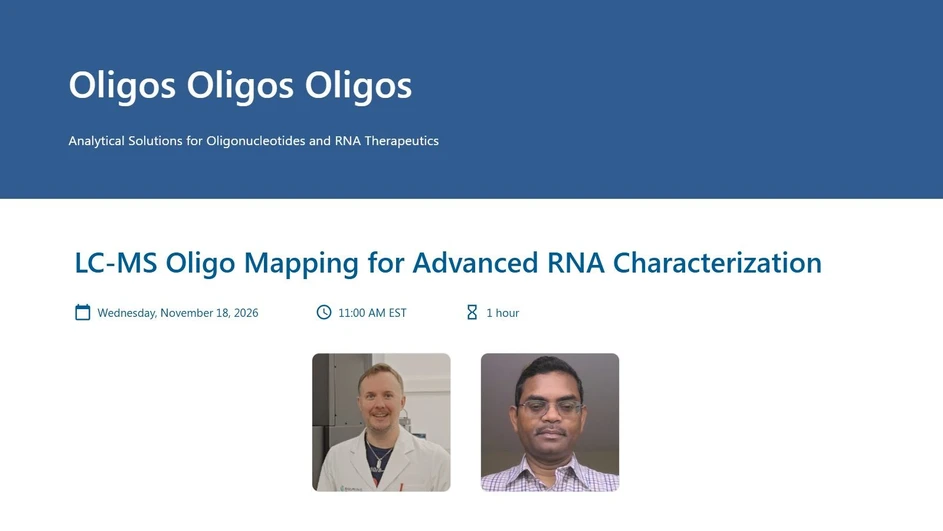
Oligonucleotide and RNA therapeutics are advancing rapidly, creating new possibilities for addressing complex diseases while increasing the need for robust, accessible analytical workflows. From synthetic oligonucleotides and antisense oligonucleotides to siRNA, mRNA, and CRISPR single-guide RNA, these molecules must be carefully characterized to confirm molecular mass, sequence identity, purity, and critical modifications. Reliable analytical methods are also essential for understanding impurities, improving method robustness, and supporting confident decisions throughout research, development, and quality control.
In this third annual, three-week webinar series, scientists from Waters Corporation and collaborators from Synthon and BioSpring will explore current challenges and practical approaches for oligonucleotide analysis. Topics will include improving the robustness of ion-pair reversed-phase LC-UV-MS methods, expanding access to walk-up mass confirmation for synthetic oligonucleotides, and applying LC-MS oligo mapping and tunable RNase digestion to advanced RNA characterization.
Join us as we explore the science of oligos and the power of LC, LC-MS, informatics, and complementary analytical workflows to characterize them with greater confidence.
Oligonucleotide drugs have become an integral part of the pharmaceutical repertoire. Together with protein and peptide drugs and analogues, they build the group of TIDES therapeutics. The rising number of diverse oligonucleotides in therapeutical applications has also brought a growing need for comprehensive quality control methods. Especially the confirmation of the base sequence has become an important part of quality control. Beside molecular biology based sequencing techniques, mass spectrometry has proven a versatile tool for the sequence confirmation of oligonucleotides. For siRNA and ASOs, mass spectrometry is already state of the art, for sgRNA various techniques have emerged to fully cover the oligonucleotide sequence and the incorporated modifications. The presentation focuses on the sequence confirmation of sgRNA using new enzymes and methodologies for full understanding of this therapeutic class. All experiments in the presentation were performed on (q)TOF instruments using latest bioinformatic workflows for easy QC implementation.
The rapid growth of RNA-based therapeutics, including mRNA vaccines and CRISPR guide RNAs (sgRNAs), has increased the demand for robust analytical methods capable of confirming sequence identity, assessing purity, and characterizing critical modifications. LC-MS-based oligo mapping has emerged as a powerful approach for comprehensive RNA characterization, enabling direct analysis of nucleic acid sequence segments and modification sites.
A key challenge in RNA sequencing workflows is generating informative digestion products that provide sufficient sequence coverage while maintaining confident assignment. This presentation highlights the use of Waters RapiZyme MC1 and RapiZyme Cusativin RNases, two complementary enzymes specifically designed for LC-MS analysis of RNA therapeutics. Through controlled and reproducible cleavage at distinct dinucleotide sites, these enzymes generate overlapping RNA fragments that improve sequence coverage, simplify data interpretation, and increase confidence in sequence confirmation and modification mapping.
Attendees will gain insight into optimized oligo mapping workflows for mRNA and sgRNA characterization, including digestion strategies, LC-MS analysis, and streamlined data processing using modern bioinformatics tools. The presentation will demonstrate how tunable RNA digestion approaches can accelerate therapeutic development while delivering deeper molecular insights for research, development, and quality control laboratories.
This webinar is designed for scientists and laboratory leaders working in RNA therapeutics, CRISPR sgRNA, mRNA, oligonucleotide sequencing, analytical development, characterization, and quality control.
Presenter: Christopher Gawlig (QC Scientist Research & Development, BioSpring)
Dr. Christopher Gawlig studied Chemistry at Justus Liebig University Giessen, Germany, where he subsequently completed his PhD in Organic Chemistry.
Since 2022, he has been working at Biospring as a QC R&D Scientist, focusing on LC-MS method development for oligonucleotides.
His research also focuses on analytical approaches for oligonucleotide sequencing, including enzymatic digestion strategies to enable the characterization of long oligonucleotides. His work has contributed to numerous scientific publications in the field.
Presenter: Martin Gilar, Ph.D. (Consulting Scientist, BioSeparations, Waters Corporation)
Bala Addepalli has an impressive background in the field of cell and gene therapy product analysis. Currently, he is a Consulting Scientist within the BioSeparations portfolio at Waters Corporation. His work focuses on developing efficient analytical approaches for characterization of DNA, RNA, LNPs (lipid nanoparticles), and viral vectors using liquid chromatography coupled with mass spectrometry or light scattering techniques.
Before joining Waters, Bala made significant contributions at the University of Cincinnati, where he developed novel enzymes and analytical methods for RNA characterization. His earlier work includes research on mRNA polyadenylation at the University of Kentucky, and viral RNA characterization during his graduate studies in India.
With over 60 publications and numerous presentations at scientific meetings, Bala's expertise is well-recognized in the scientific community.