ZÁZNAM | Proběhlo St, 14.10.2026
Připojte se na webinář Waters a Synthon o LC-UV-MS analýze oligonukleotidů. Zjistěte, jak zvýšit robustnost a přesnost charakterizace.Přejít na webinář
Oligonucleotide and RNA therapeutics are advancing rapidly, creating new possibilities for addressing complex diseases while increasing the need for robust, accessible analytical workflows. From synthetic oligonucleotides and antisense oligonucleotides to siRNA, mRNA, and CRISPR single-guide RNA, these molecules must be carefully characterized to confirm molecular mass, sequence identity, purity, and critical modifications. Reliable analytical methods are also essential for understanding impurities, improving method robustness, and supporting confident decisions throughout research, development, and quality control.
In this third annual, three-week webinar series, scientists from Waters Corporation and collaborators from Synthon and BioSpring will explore current challenges and practical approaches for oligonucleotide analysis. Topics will include improving the robustness of ion-pair reversed-phase LC-UV-MS methods, expanding access to walk-up mass confirmation for synthetic oligonucleotides, and applying LC-MS oligo mapping and tunable RNase digestion to advanced RNA characterization.
Join us as we explore the science of oligos and the power of LC, LC-MS, informatics, and complementary analytical workflows to characterize them with greater confidence.
Ion-pair reversed-phase LC-UV-MS is widely used to characterize and assess the purity of therapeutic oligonucleotides, yet performance can be affected by trace metal contamination, mobile phase additive quality, and MS source conditions. In this webinar, we examine the impact of sodium contamination in mobile phases, compare HFIP from different manufacturers, and use DoE to optimize key MS source parameters. Learn how solvent and additive selection, together with systematic source optimization, can reduce sodium adduct formation, improve MS purity and UV baseline quality, and strengthen method robustness for R&D and routine GMP/QC analysis.
Ion-pair reversed-phase LC-MS is a powerful technique for separating and characterizing therapeutic oligonucleotides, yet chromatographic performance can depend on column chemistry, mobile-phase composition, and the quality of ion-pairing reagents. In this webinar, we explore how reversed-phase column selection and HFIP-based mobile phases influence oligonucleotide retention, selectivity, peak shape, and MS compatibility. Learn how thoughtful column and mobile-phase choices can improve separations, strengthen analytical confidence, and support robust oligonucleotide characterization across research, development, and routine analysis.
This webinar is designed for scientists, analytical chemists, method-development specialists, QC/GMP laboratory professionals, and laboratory managers working in therapeutic oligonucleotide development, manufacturing, impurity analysis, and LC-MS characterization.
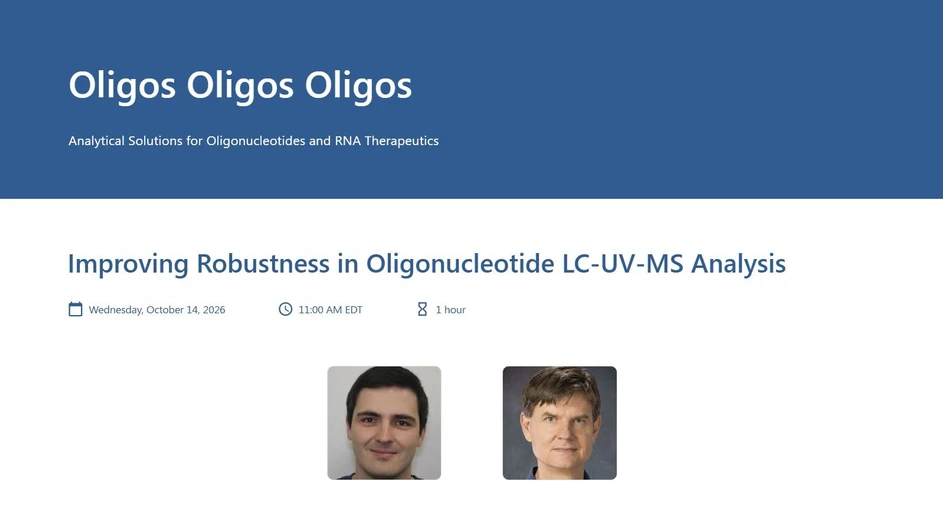
Presenter: Jan Fučík (Mass Spectrometry Specialist for Oligonucleotides, Synthon)
Jan holds a Master’s degree in Chemistry for Medical Applications and a Ph.D. in Analytical and Environmental Chemistry from Brno University of Technology. He has more than six years of experience across a broad range of mass spectrometry techniques, with particular expertise in LC-MS method development using Design of Experiments (DoE) and Analytical Quality by Design (AQbD), sample preparation (SPE and QuEChERS), statistical data evaluation, and instrument troubleshooting.
His work spans targeted and untargeted analysis of small molecules, including pharmaceutical residues and monomers used in polymer production. For more than two years, Jan has focused on oligonucleotide analysis in Synthon’s R&D Analytical/Oligonucleotide Department. There, he develops LC-UV and LC-UV-MS methods for oligonucleotide therapeutics, troubleshoots instruments and analytical methods, and addresses the day-to-day challenges posed by these complex molecules.
Jan also uses Python scripting to automate data processing and develop tools that streamline mass-spectrometry workflows.
Presenter: Martin Gilar, Ph.D. (Scientific Fellow, Separations R&D group, Waters Corporation)
Dr. Martin Gilar received his Ph.D. in analytical chemistry from Institute of Chemical Technology in Prague (1996). He spent postdoc years in Hybridon Inc. (1996-1998) and Northeastern University in Boston (1998) developing separation methods for antisense oligonucleotides and fraction collector for DNA molecules. Since 1998 he has worked at Waters Corp. in Milford, Massachusetts, participating in column, sample preparation and instrument research.
Dr. Martin Gilar is a Scientific Fellow in the Separations R&D group at Waters Corporation. He has more than 30 years of experience in the separation sciences, including chromatography, electrophoresis, and mass spectrometry.
His research interest is the analysis of biopolymers, peptides, and nucleic acids. He has published over 75 peer reviewed papers.
Dr. Gilar is recipient of Jaroslav Janak 2022 medal and Chromatographic Society Jubilee medal in 2023.